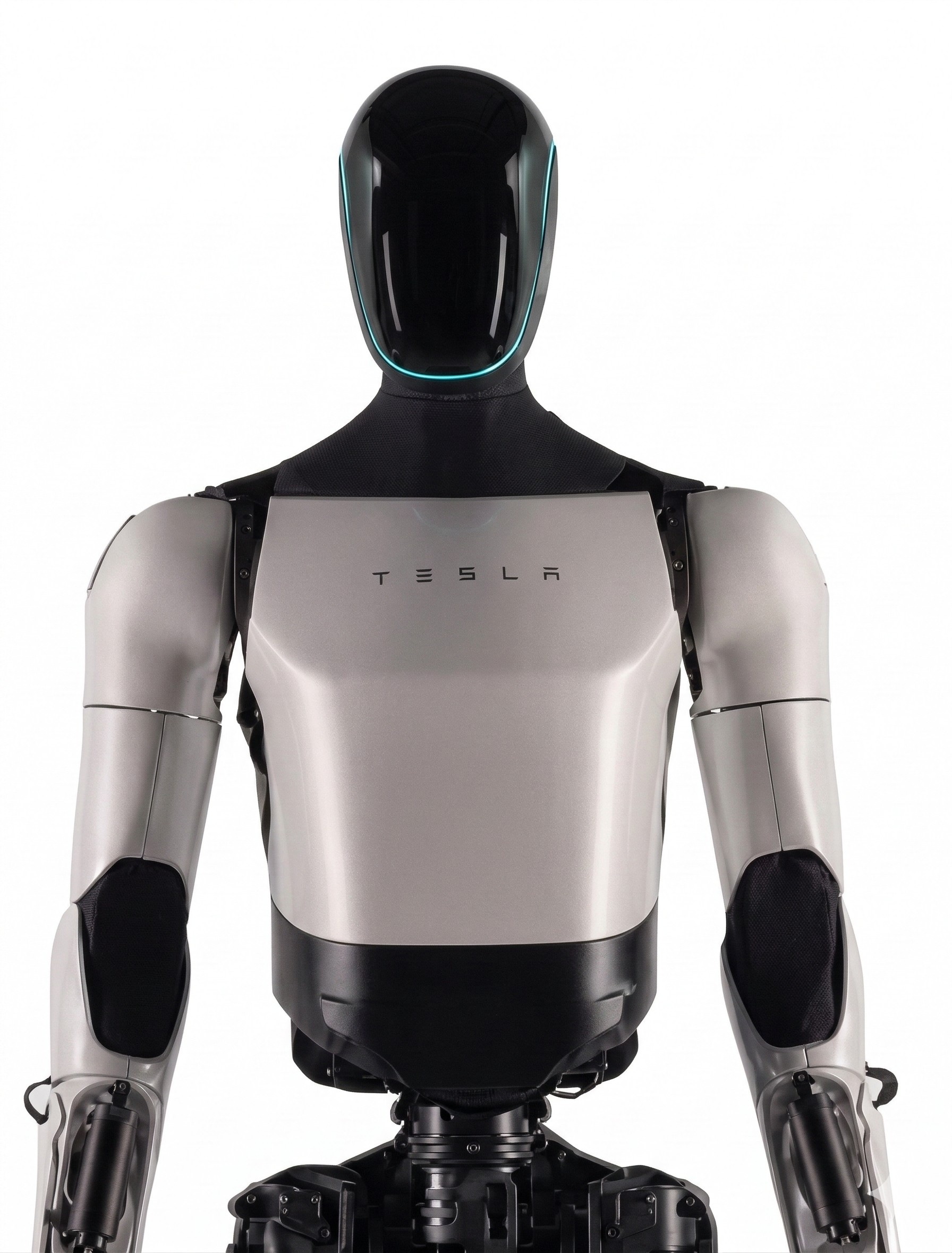
Tesla Optimus learns tasks by watching human videos, refining those movements in simulation, and improving across a connected fleet. The robot runs on the same neural network that powers Tesla’s Full Self-Driving system. Observation is the starting point, not the finished skill. The same architecture that drives a Tesla car now drives a humanoid robot. This shift from programmed machines to learning machines defines Optimus Gen 3.
Lars Talbert breaks down the learning shift in the video below.

Tesla Optimus Learning by Watching Human Video
Optimus acquires new skills by observing humans perform a task, then copying the motion. Tesla feeds the robot first-person video of people folding laundry, sorting objects, and stirring a pot. The neural network converts that footage into motor commands. No engineer writes code for each movement.
A traditional factory robot follows fixed instructions. A welding robot repeats the same weld point on a car frame thousands of times at near-perfect accuracy. A slightly different task makes the programmed robot fail. The programmed robot executes instructions without understanding the task.
Optimus learns patterns, then applies them across many tasks. Milan Kovac, Tesla’s Vice President for Optimus, described the breakthrough on X: the team can now transfer a large share of learning directly from human videos to the robots, with new skills called up through plain voice or text commands and run by a single neural network.
For full technical specifications, target pricing, and hardware dimensions, visit our Optimus by Tesla Directory Profile
How the FSD Neural Network Powers Optimus Learning
Optimus is powered by an adapted version of Tesla’s Full Self-Driving (FSD) system. Tesla did not build the robot’s intelligence from scratch. Tesla repurposed an end-to-end neural network already trained on billions of miles of driving data.
Raw camera footage goes in. Physical action comes out. No hand-coded rulebook sits in between. Tesla’s FSD software replaced hundreds of thousands of lines of traditional programming with a single neural network that consumes pixels and produces movement. Optimus inherits that exact approach.
The visual processing and spatial awareness built for driving now map onto a bipedal body. The car and the robot are two physical forms of the same core technology.
We explained this strategic pivot in detail in our analysis of why Tesla is now a robotics company, not a car company.
Tesla Optimus Learning Pipeline: Three Stages
Optimus learns through a three-stage pipeline that combines video observation, simulation, and fleet-wide sharing. Most coverage stops at stage one. Each stage solves a problem that the previous one cannot.
Stage One: Imitation Learning From Video
Optimus begins by watching humans and copying their motions. Tesla records workers performing everyday actions through a five-camera helmet rig and a backpack sensor pack. The robot studies these demonstrations and reproduces the spatial movements, hand positions, and timing.
The newest advance pushes this toward open video. Tesla’s goal is for Optimus to learn directly from internet footage, including third-person clips captured by random cameras.
Elon Musk has framed this as the robot eventually learning from how-to videos the way a person watches a tutorial. The robot studies the demonstration, then attempts the task.
Stage Two: Simulation Refinement
Optimus practices each observed task thousands of times in a simulated environment before acting in the real world. Video alone captures movement, but it cannot teach physics. A clip of someone stirring a pot does not show how much force keeps the pot from sliding off the stove.
Tesla solves this with synthetic data. Tesla uses video-generation models as physics engines, creating thousands of simulated versions of a single task. Optimus runs the action repeatedly inside these simulations, learning grip adjustments and edge cases without moving a physical joint.
Stage Three: Fleet Learning and the Data Flywheel
Once one Optimus robot masters a task, the skill spreads to every other unit. Tesla deploys physical robots to perform tasks, record successes and failures, and upload that data back to a central system. The robots test and retest in a process Tesla calls self-play.
Fleet self-play creates a data flywheel. Every Optimus robot improves every other Optimus robot. The fleet learns collectively. One unit’s new skill becomes available to all, which scales faster than any single robot.
How Optimus Learning Differs From Programmed Robots
The core difference between Optimus and a traditional robot is how each one acquires a skill. A learning robot observes and generalizes. A programmed robot follows explicit code.
| Feature | Optimus (Learning) | Traditional Robot (Programmed) |
|---|---|---|
| Method | Watches human video and imitates the action | Engineers write step-by-step code for each movement |
| Adaptability | Handles new objects, lighting, and placements | Fails when conditions change in the script |
| Scaling | Learns from millions of human examples | Every edge case must be coded by hand |
| Best use | Messy, unpredictable real-world tasks | Fixed, repetitive tasks with strict rules |
A programmed robot improves only when an engineer writes more code. A learning robot improves when it receives more data. That moves the bottleneck from engineering hours to data volume, and data scales far faster than hand-written code.
Why Optimus Learning Matters for Investors
The learning approach changes the improvement curve for humanoid robots, which matters more than any one task Optimus performs. A robot that learns from data improves on a different timeline than one built on fixed programming. Progress no longer depends only on engineering cycles.
Tesla pairs this learning system with manufacturing scale. Tesla builds the AI infrastructure, the custom AI5 inference chips, and the production capacity to make units at volume.
Tesla has deployed over 1,000 Optimus units across its facilities in Texas and Fremont, where the robots perform real factory-floor tasks. To see how this scale translates into company valuations, track the numbers in our humanoid robotics funding tracker.
A general-purpose robot that learns visually opens markets beyond the factory: logistics, retail, healthcare support, and the home. To compare how each company approaches this race, track specifications, and progress across all 31 manufacturers in our humanoid robot directory.
What Learning by Watching Still Cannot Do
Optimus faces real limits in dexterity, reliability, and physical reasoning that video learning has not yet solved. A robot that copies a video performs well in a controlled demo. The open world is harder.
Why Video Learning Misses Force and Feedback
Video captures motion, but misses the feedback signals a human uses automatically. Picking up a coffee cup involves hundreds of micro-adjustments based on weight, balance, and grip.
A clip of someone lifting a cup looks identical for a full cup and an empty one. The robot recovers that missing information through simulation and trial.
Where Learned Autonomy Still Relies on Teleoperation
At Tesla’s We Robot event, many Optimus units interacting with the crowd were teleoperated by humans rather than acting on their own.
Demonstration footage across the humanoid robot industry is often sped up and selectively edited, not only by Tesla. The controlled demo and the deployed reality remain different, a gap we cover in our $20,000 humanoid robot reality check.
How Other Humanoid Robots Learn by Watching
Several humanoid developers now use the same video-to-action learning approach, and Optimus is one entry in a wider field. Training a robot from human demonstration is now a shared industry direction, not a Tesla exclusive.
1X Technologies trains its NEO home robot on a world model that converts video into action sequences, with a focus on safe operation around people. You can review the platform in our 1X NEO robot profile.
Figure AI takes a parallel path with its Helix Vision-Language-Action model, which lets the robot learn household chores by watching humans. Figure demonstrated this when its humanoid made a bed from visual learning.
Frequently Asked Questions
Is Tesla Optimus controlled by humans?
It depends on the setting. During data collection and some public demonstrations, operators teleoperate the robot using motion-capture rigs. The trained tasks shown in Tesla’s learning videos run on the robot’s own neural network, not a human controller.
Can Optimus really learn from YouTube videos?
Tesla transfers learning from first-person human video and is extending the method to third-person internet footage. The robot still refines each task in simulation before performing it reliably.
Is the Optimus dancing and kung fu footage real?
The movement is real robot motion, but it is trained and rehearsed, often using imitation learning combined with reinforcement learning in simulation. The demos show capability, not a single autonomous performance from scratch.
What tasks can Tesla Optimus do now?
Optimus has been shown folding clothes, sorting objects, stirring a pot, sweeping, vacuuming, and placing automotive components. Over a thousand units operate in Tesla facilities on real factory tasks.
Key Takeaways
Tesla Optimus learns through video observation, simulation refinement, and fleet-wide self-play, all powered by the same neural network behind Tesla’s cars. The core change is the move from machines told what to do toward machines that learn how to do it.
- Learning-by-watching is stage one of a three-stage pipeline, not the entire system.
- Optimus runs on an adapted FSD neural network: pixels in, action out.
- The improvement curve now depends on data, which scales faster than code.
- Real limits remain in dexterity, physical reasoning, and autonomous reliability.
The Robotic Life tracks the companies, robots, and funding shaping the humanoid robotics economy through a business lens. To follow how Optimus and its rivals develop in real time, explore the full humanoid robot directory and see the wider context in our look at the global race to build physical AI.