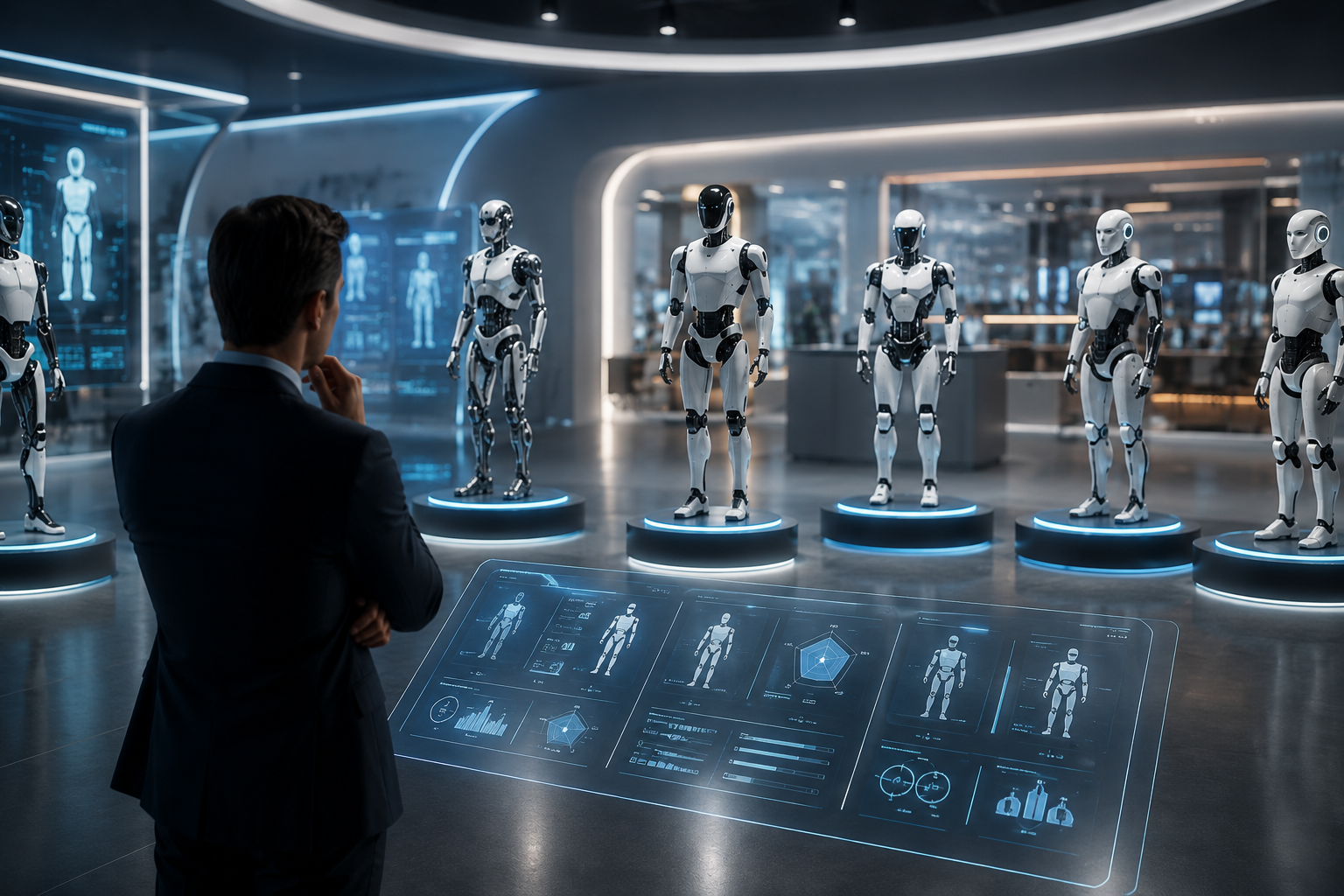
As of January 2026, marketing videos make it look like the future has arrived. The buyer reality is more measured.
For most consumers in 2026, humanoid robots are not yet consumer-ready. The Unitree G1 ships from $16,000 as a developer platform. The 1X NEO ships at $20,000 plus a $499 monthly subscription as a pre-order beta.
Tesla Optimus and Figure 03 remain in factory and industrial deployments with no consumer availability. The full humanoid landscape sits in our humanoid robot directory.
Lars Talbert breaks down the 2026 humanoid buyer reality in the video below.

Can You Buy a Humanoid Robot in 2026?
Yes. Two humanoid robots are available for purchase or pre-order in 2026: the Unitree G1 and the 1X NEO. Both ship around the $20,000 price point but serve completely different use cases.
The 2026 humanoid market splits into three tiers by availability and buyer-readiness criteria. The Unitree G1 ships today as a developer platform. The 1X NEO ships on pre-order as a home pilot program with significant human-in-the-loop assistance.
Tesla Optimus and Figure 03 remain limited to factories and industrial partners. The AI Overview for the query opens with the same answer: for most consumers, the technology is not yet ready.
The Research Class: Humanoid Robots Available Today
The Research Class includes humanoid robots available for outright purchase in 2026. The category is led by Unitree, the manufacturer driving down humanoid costs the fastest.
Unitree G1 ($16,000 to $28,000)
The Unitree G1 ranges from $16,000 for the base configuration to roughly $28,000 for the EDU model with expanded degrees of freedom and dexterous hands. RoboStore lists the G1 at $17,990. The Unitree official shop lists the base unit at $13,500 with EDU upgrades available.
The G1 ships as a developer platform, not a consumer assistant. The robot operates on ROS2 with full SDK and API access. Out of the box, the G1 performs basic locomotion, balance recovery, and pre-programmed movements.
Custom tasks like household chores require dedicated programming work. The G1 measures 132 centimeters tall, weighs 35 kilograms, and delivers roughly two hours of active battery life. Full specifications sit in our Unitree G1 robot profile.
The buyer’s reality:
- Without coding capability, the G1 functions as a research and demonstration tool rather than a home assistant
- The platform suits universities, robotics labs, and engineering teams
- Unitree also ships the cheaper R1 platform for $5,900, signaling continued price compression across the lineup
The Pre-Order Class: The 1X NEO Home Pilot Program
The 1X NEO is the closest humanoid to a true home assistant available in 2026. The robot ships through a pre-order program at $20,000 with a $200 deposit and a $499 monthly subscription option.
1X NEO ($20,000 outright or $499 per month)
The 1X NEO is engineered by 1X Technologies, a humanoid robotics company backed by OpenAI. The robot uses tendon-driven motors and lightweight materials for safer interaction in home environments. NEO measures 165 centimeters tall, weighs 30 kilograms, and runs for 2 to 4 hours per charge.
The 1X deployment model relies on a hybrid AI plus human-teleoperation system. The Wall Street Journal reported in October 2025 that much of the NEO initial work is performed by a remote human operator.
Early users participate in a data-collection program that helps the AI learn household tasks.
Full specifications and the NEO design philosophy sit in our 1X NEO robot profile.
The buyer reality:
- First-generation home hardware carries the standard risk of any new product category
- Teleoperation involvement varies by task and improves as the AI learns
- The subscription model implies ongoing service costs beyond the purchase price
The Forbidden Class: Humanoid Robots You Cannot Buy
Tesla Optimus and Figure 03 lead the humanoid headlines in 2026 but remain unavailable to consumer buyers. Both robots operate in factory and industrial pilots only.
Tesla Optimus (target $20,000 to $30,000, not shipping)
Tesla projects an Optimus consumer price between $20,000 and $30,000. The robot remains in internal factory deployment with no consumer availability as of June 2026.
Over 1,000 Optimus units operate across Tesla facilities, learning factory tasks through imitation video and reinforcement learning, as covered in our analysis of how Tesla Optimus learns by watching.
Figure 03 (commercial deployment, roughly $130,000)
Figure 03 by Figure AI ships to industrial partners at a reported price near $130,000. The robot operates inside BMW manufacturing facilities in Spartanburg and Brooks Brothers logistics operations.
Figure 03 demonstrated home tasks, including bed-making in 2026, documented in our Figure 03 made-the-bed analysis, though consumer deployment is not yet scheduled.
The buyer’s reality:
- Industrial deployments validate the hardware platform, but do not equal consumer readiness
- Factory environments differ from homes in safety requirements, task variability, and supervision needs
- Consumer pricing targets remain projections, not confirmed retail figures
How Much Does a Humanoid Robot Cost in 2026?
Humanoid robot prices in 2026 range from $5,900 for educational platforms to over $250,000 for industrial models. The most-discussed consumer tier sits at $16,000 to $30,000.
| Tier | Price Range | Representative Model | Availability |
| Educational | $1,400 to $10,000 | Noetix Bumi, Unitree R1 | Available |
| Developer Platform | $13,500 to $28,000 | Unitree G1 | Available |
| Consumer Pre-Order | $20,000 + $499/month | 1X NEO | Pre-order |
| Industrial Pilot | $130,000 to $250,000 | Figure 03, Agility Digit | B2B only |
| Premium Industrial | $400,000+ | Boston Dynamics Atlas | B2B only |
Pricing sourced from RoboStore, the Unitree official shop, Robozaps, CNET, Forbes, and AI Overview data current to 2026.
Total cost of ownership extends beyond purchase price. Industry analysts estimate annual maintenance at 10 to 20 percent of the purchase price for industrial humanoids. Subscription models add recurring monthly costs.
Why Waiting May Be the Rational Buyer Choice in 2026
For most consumers in 2026, waiting is the rational choice. The technology improves rapidly, prices continue falling, and second-generation home models are expected in the 2027 to 2028 window.
Three signals support the wait-and-see position:
- Price decline trajectory: Humanoid prices dropped meaningfully through 2024 and 2025. The Unitree R1 launched at $5,900 in mid-2025. Tesla projects sub-$30,000 Optimus pricing. Patient buyers benefit from continued cost compression.
- Capability improvement curve: First-generation hardware in any product category typically gets replaced by second-generation models within 18 to 24 months. The 1X NEO hybrid AI improves as more deployment data accumulates.
- Safety and reliability data: Long-term home deployment data does not exist yet. The first wave of buyers generates that data. Patient buyers benefit from documented reliability before purchase.
This is buyer guidance, not financial or purchase advice. Individual circumstances determine the right choice.
Frequently Asked Questions
Can you buy a humanoid robot in 2026?
Yes. The Unitree G1 ships from $16,000 as a developer platform. The 1X NEO is on pre-order at $20,000 or $499 monthly. Tesla Optimus and Figure 03 remain unavailable to consumers.
How much does a humanoid robot cost in 2026?
Humanoid robots range from $5,900 for educational platforms to over $250,000 for industrial models. The consumer tier sits at $16,000 to $30,000.
What is the best humanoid robot for home use in 2026?
The 1X NEO is the only humanoid currently designed and shipping for home environments. The robot uses tendon-driven motors for soft, quiet movement and relies on a hybrid AI-plus-teleoperation system during early deployment.
Is the Unitree G1 worth $16,000?
The Unitree G1 delivers value for robotics developers, university labs, and engineering teams writing custom software. Consumer buyers without coding capability will find the G1 limited to pre-programmed demonstrations.
When will consumer humanoid robots be ready?
Industry analysts project second-generation home humanoid models in the 2027 to 2028 window, with delivery timelines not yet confirmed.
Key Takeaways
For most consumers in 2026, humanoid robots remain a developing technology rather than a household-ready product. The buyer reality:
- Available today: Unitree G1 at $16,000 to $28,000 as a developer platform
- Pre-order: 1X NEO at $20,000 outright or $499 monthly subscription with hybrid AI plus teleoperation
- Unavailable to consumers: Tesla Optimus and Figure 03, deployed in factory and industrial pilots only
- Rational paths: Develop on the G1, beta-test the NEO, or wait for second-generation home models
The broader competitive landscape across all six categories of robotics sits in our complete guide to autonomous robot companies. This is buyer guidance, not financial or purchase advice. Individual circumstances determine the right choice.