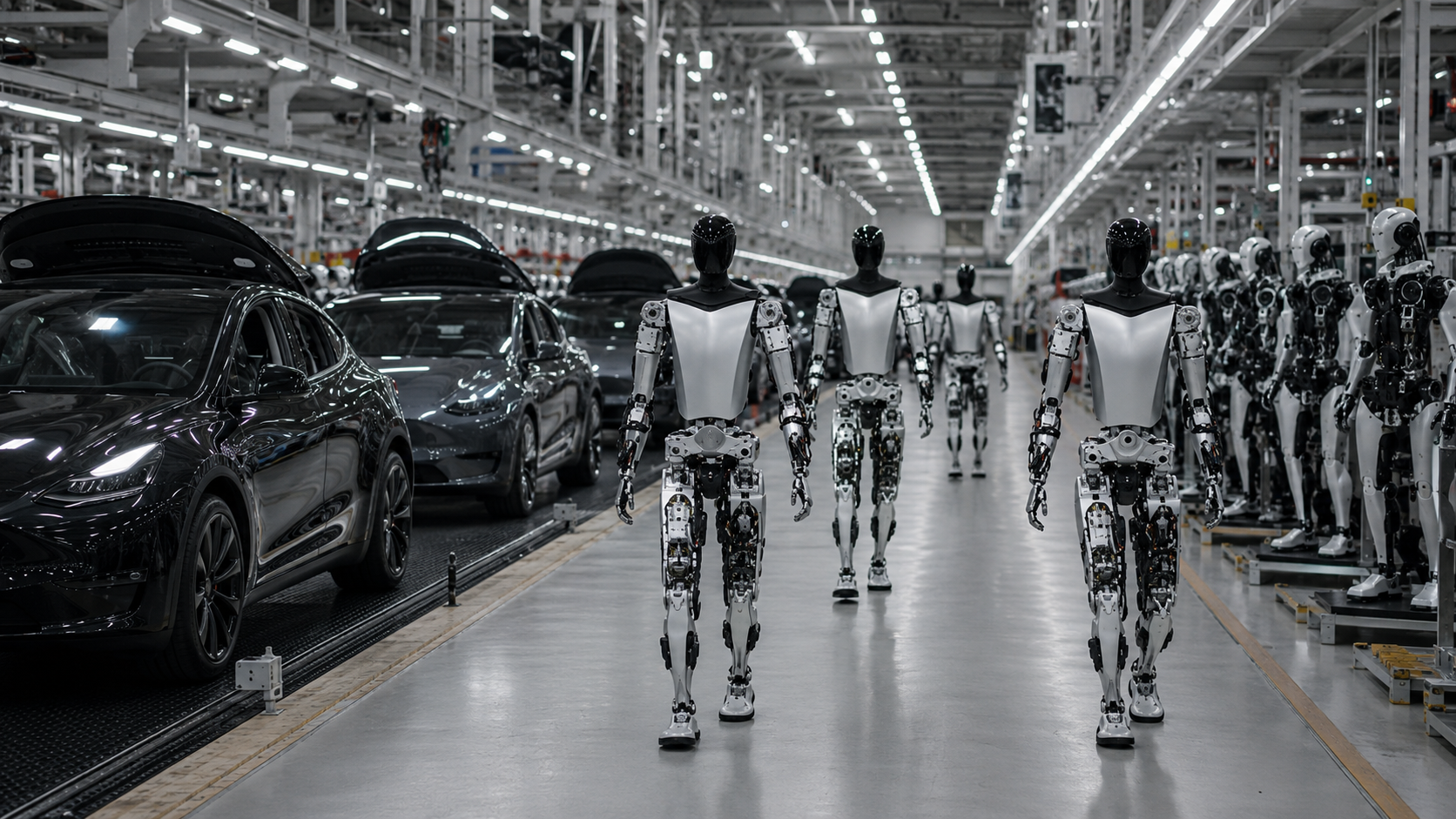
Tesla used its Q1 2026 earnings call on April 22, 2026 to confirm the company’s pivot toward humanoid robotics manufacturing. Optimus Gen 3 production begins at the Fremont factory in late July or August 2026 per CEO Elon Musk. Tesla raised 2026 capital expenditure guidance to $25 billion, roughly three times the prior year’s $8.5 billion baseline. The Cortex 2.0 AI training infrastructure reached critical operational phases. Revenue hit $22.39 billion for the quarter, up 16 percent year over year, with gross margin improving to 21.1 percent. Tesla shares dropped approximately 3.5 percent after the report despite the earnings beat. The financial reality remains anchored to automotive.

Q1 2026 Earnings Confirmed the Tesla Robotics Pivot at a Verifiable Cost
Tesla’s Q1 2026 earnings call on April 22, 2026 confirmed three things: the Optimus production timeline, the capital commitment behind it, and the financial trade-off Tesla is making to fund it.
The Q1 2026 financial headline numbers
Tesla revenue reached $22.39 billion for Q1 2026, up 16 percent year over year per The Verge and Stock Titan. Adjusted EPS hit $0.41, beating estimates of $0.36. Gross margin improved to 21.1 percent, up roughly five percentage points year over year. GAAP net income came in at $0.5 billion. Non-GAAP net income was $1.5 billion.
Despite the beat, Tesla shares dropped approximately 3.5 percent after the report per TIKR. The market reaction signaled investor concern about the CapEx trajectory.
What the $25 billion CapEx number represents
Tesla raised 2026 capital expenditure guidance to $25 billion on the April 22 call per Bloomberg and INDmoney. The figure is roughly three times the $8.5 billion prior baseline. CFO Vaibhav Taneja signaled likely negative free cash flow for the remainder of 2026. The $25 billion covers Cortex 2.0 AI training infrastructure, Optimus production tooling at Fremont, Cybercab manufacturing, and semiconductor research partnerships.
Tesla Optimus Production 2026 Starts at Fremont in Late Summer
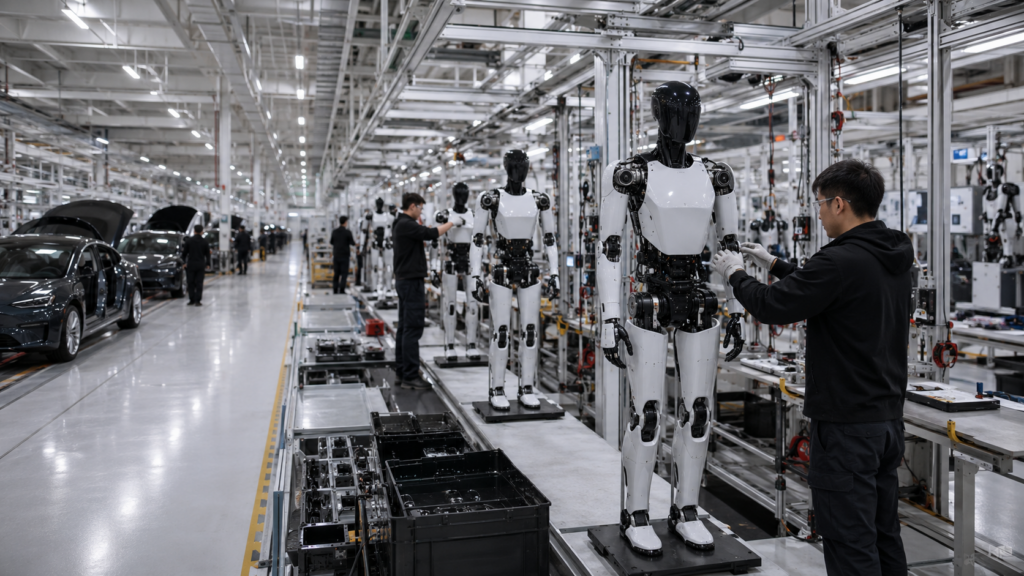
Tesla Optimus Gen 3 production begins at the Fremont factory in late July or August 2026 per Elon Musk’s confirmation on the April 22 earnings call covered by Electrek.
The Fremont production line conversion
Tesla announced the Model S and Model X wind-down on January 28, 2026 during the Q4 2025 earnings call per NBC News reporter David Ingram. Musk’s phrasing was “wind down S and X production next quarter and basically stop production.” The two vehicles, launched in 2012 and 2015, helped move electric vehicles into the mainstream per NBC News.
The Q1 2026 call on April 22 confirmed the Fremont conversion was progressing per BBC and Business Insider. The January call was the announcement. The April call was the implementation update.
The 1 million units per year framing
The 1 million units per year figure is the Fremont capacity target, not 2026 production volume. Initial 2026 Optimus output is estimated at approximately 25,000 units per Nomura research analysis of industry supply chain signals. The gap between announced capacity and initial production is the deployment story.
Tesla’s Giga Texas Optimus facility is projected online in 2027, with a long-term target of 10 million units per year. The Robot of the Week post covers Optimus Gen 3 hardware specifications, including 22 degrees of freedom in the hands and 50 actuators: Optimus Gen 3 technical breakdown.
The Tesla $25 Billion CapEx Ramp Is a Vertical-Integration Bet
The $25 billion 2026 capital expenditure commitment positions Tesla as the most vertically integrated humanoid robotics manufacturer in the industry.
What vertical integration means for Tesla’s robotics stack
Tesla owns the silicon layer through the in-house AI5 chip, the compute layer through Cortex 2.0, the software layer through the vision-based neural network architecture shared between Full Self-Driving and Optimus, the manufacturing layer through Fremont and Giga Texas, and the training data layer through the Full Self-Driving fleet that feeds Optimus pipelines.
Most humanoid robotics competitors depend on third-party silicon, third-party cloud compute, or both. The category landscape and funding positions of competing companies sit inside the autonomous robot companies funding tracker.
The risk profile of $25 billion against a softening core
Yahoo Finance framed the Q1 2026 update as Tesla “reframing growth around AI robots and robotaxis.” The 3.5 percent stock drop after the earnings beat suggests Wall Street caution about the CapEx-to-core ratio. INDmoney cited the CFO’s negative free cash flow guidance as a material driver of the reaction.
Cortex 2.0 and AI5 Power Tesla’s Robotics Brain Stack
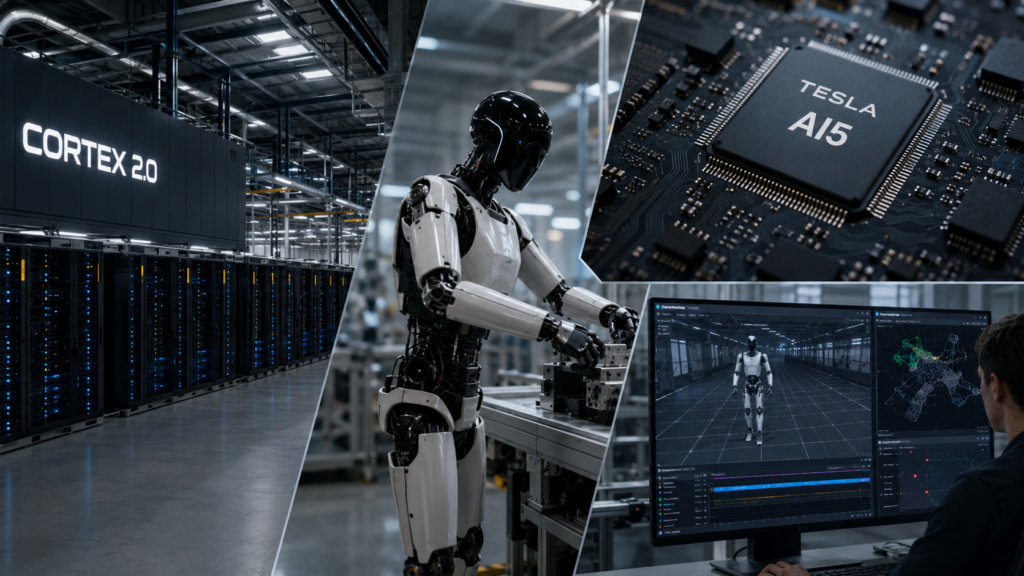
Tesla’s robotics push depends on two pieces of proprietary infrastructure: the Cortex 2.0 AI training cluster and the AI5 inference chip.
Cortex 2.0 AI training infrastructure
Cortex 2.0 reached critical operational phases per Tesla’s Q1 2026 update. The infrastructure trains both Optimus and Full Self-Driving on a shared compute foundation at approximately 500 megawatt scale.
AI5 chip and Optimus integration
Tesla’s Q1 2026 update referenced continued build-out of the AI software supporting autonomous systems. The AI5 chip powers both Cybercab and Optimus inference workloads. The vertical silicon strategy mirrors Tesla’s in-house Full Self-Driving chip development.
Digital Optimus and simulation training
Tesla’s Optimus training methodology includes simulated environment pre-training before physical factory deployment. The training data flywheel connecting Full Self-Driving to humanoid robotics represents a strong cross-product synergy. The video-based learning architecture that lets Optimus learn from observation sits inside the Optimus Gen 3 learning system breakdown.
Tesla’s Robotics Narrative Outpaces Tesla’s Automotive Reality
Despite the Q1 2026 earnings narrative, the automotive business still drives the vast majority of Tesla’s financial performance, and the robotics pivot is being funded from a softening core.
The Electrek skeptic framing
Electrek published the sharpest skeptic position the day before Tesla’s Q1 2026 earnings call. The April 21, 2026 Electrek framing: “Despite Tesla leadership continuing to push the narrative that Tesla is now an ‘AI and robotics company,’ the automotive business still drives the vast majority of Tesla’s financial performance.”
Humanoid robotics generated negligible reported revenue in Q1 2026. The category narrative has shifted faster than the category financials.
Three competing reads of the Tesla pivot
The Musk read says Tesla has fundamentally transformed, with the Fremont conversion, the $25 billion CapEx, Cortex 2.0, and AI5 all confirming the shift.
The analyst-narrative read, per Yahoo Finance and Bloomberg, says Tesla is reframing growth around AI robots and robotaxis. Major investors are taking the framing seriously.
The Electrek skeptic read says cars pay the bills. The Q1 2026 stock drop suggests Wall Street is weighing the CapEx-versus-core trajectory carefully. The skeptic position is the most defensible based on Q1 2026 revenue composition.
The Meta CapEx Comparison Sharpens the Tesla Question
The Meta Platforms 2021 Metaverse pivot offers the closest recent parallel to Tesla’s robotics CapEx commitment, with one critical difference.
Meta poured an estimated $70 to $80 billion into Reality Labs between 2021 and 2024 before Mark Zuckerberg’s 2023 “Year of Efficiency” pullback. The Metaverse was funded from a profitable Facebook advertising core. Tesla is funding $25 billion in annual CapEx from an automotive business showing softening demand signals. Meta bet on behavioral change. Tesla bets on labor economics. The defensibility of the comparison sits in the differences between the two pivots.
What the Tesla Robotics Pivot Signals for the Broader Humanoid Industry
Tesla’s vertical integration model raises the bar for every competing humanoid robotics company.
Most competitors depend on partner silicon, partner compute, or partner data pipelines. Tesla owns the full stack from chip design through training data generation. The competitive baseline for category leadership shifts upward. The broader industry context, including the 31 humanoid robotics developers The Robotic Life tracks, sits inside the rise of physical AI and the global race to build autonomous robots.
Frequently Asked Questions
Did Tesla stop making cars to make robots?
Tesla did not stop making cars. Tesla announced on its Q4 2025 earnings call on January 28, 2026 the wind-down of Model S and Model X production to convert Fremont lines for Optimus humanoid robot manufacturing per NBC News. Tesla continues to produce the Model 3 and Model Y at scale.
When does Tesla Optimus production start in 2026?
Tesla Optimus Gen 3 production begins at Fremont in late July or August 2026 per Elon Musk’s confirmation on the April 22, 2026 Q1 2026 earnings call covered by Electrek.
What is Tesla Cortex 2.0?
Cortex 2.0 is Tesla’s AI training infrastructure used to train Optimus and Full Self-Driving. Tesla reported on its Q1 2026 update that Cortex 2.0 reached critical operational phases.
Is Tesla a robotics company?
Tesla leadership has positioned the company as an AI and robotics company since the January 2026 Q4 2025 earnings call. The automotive business still drives the majority of Tesla’s reported revenue per Electrek. The category transition is ongoing.
How many Optimus robots will Tesla make in 2026?
Tesla’s Fremont factory has a 1 million unit per year capacity target. Initial 2026 production is estimated at approximately 25,000 units per Nomura research.
Key Takeaways: Tesla Q1 2026 Robotics Pivot
Tesla’s Q1 2026 earnings call on April 22, 2026 confirmed the humanoid robotics pivot at $25 billion in 2026 CapEx, roughly three times the prior baseline. Optimus Gen 3 production begins at Fremont in late July or August 2026. Initial 2026 output is estimated at approximately 25,000 units against a 1 million unit per year capacity target.
The Model S and Model X discontinuation was announced on the January 28, 2026 Q4 2025 call, not the Q1 2026 call. Cortex 2.0 is the verified name of Tesla’s AI training infrastructure. The automotive business still drives the majority of Tesla revenue. Meta funded its Metaverse CapEx ramp from a profitable core. Tesla is funding its robotics CapEx from a softening one.
Disclaimer
The Robotic Life provides informational coverage of humanoid robotics companies and industry developments. Nothing in this article constitutes investment advice. Readers considering financial decisions based on Tesla’s robotics strategy should consult a qualified financial advisor.
Sources
- Tesla Q1 2026 Update PDF
- The Verge, Tesla Q1 2026 earnings coverage, April 22, 2026
- Yahoo Finance, “Tesla Reframes Growth Around AI Robots And Robotaxis,” April 22, 2026
- Bloomberg, Tesla $25B AI and robotics spending plan, April 22, 2026
- INDmoney, Tesla CapEx and stock reaction analysis, April 22, 2026
- TIKR, Tesla Q1 2026 stock performance data
- Electrek, Tesla Optimus production timeline and skeptic positioning, April 21 and 22, 2026
- NBC News, Model S and Model X discontinuation announcement, David Ingram byline, January 28, 2026
- BBC, “Tesla cuts car models in shift to robots and AI,” January 28, 2026
- Business Insider, Tesla transitioning away from legacy products, January 29, 2026
- Stock Titan, Tesla Q1 2026 revenue confirmation
- Nomura research, Optimus 2026 production projection via supply chain signals