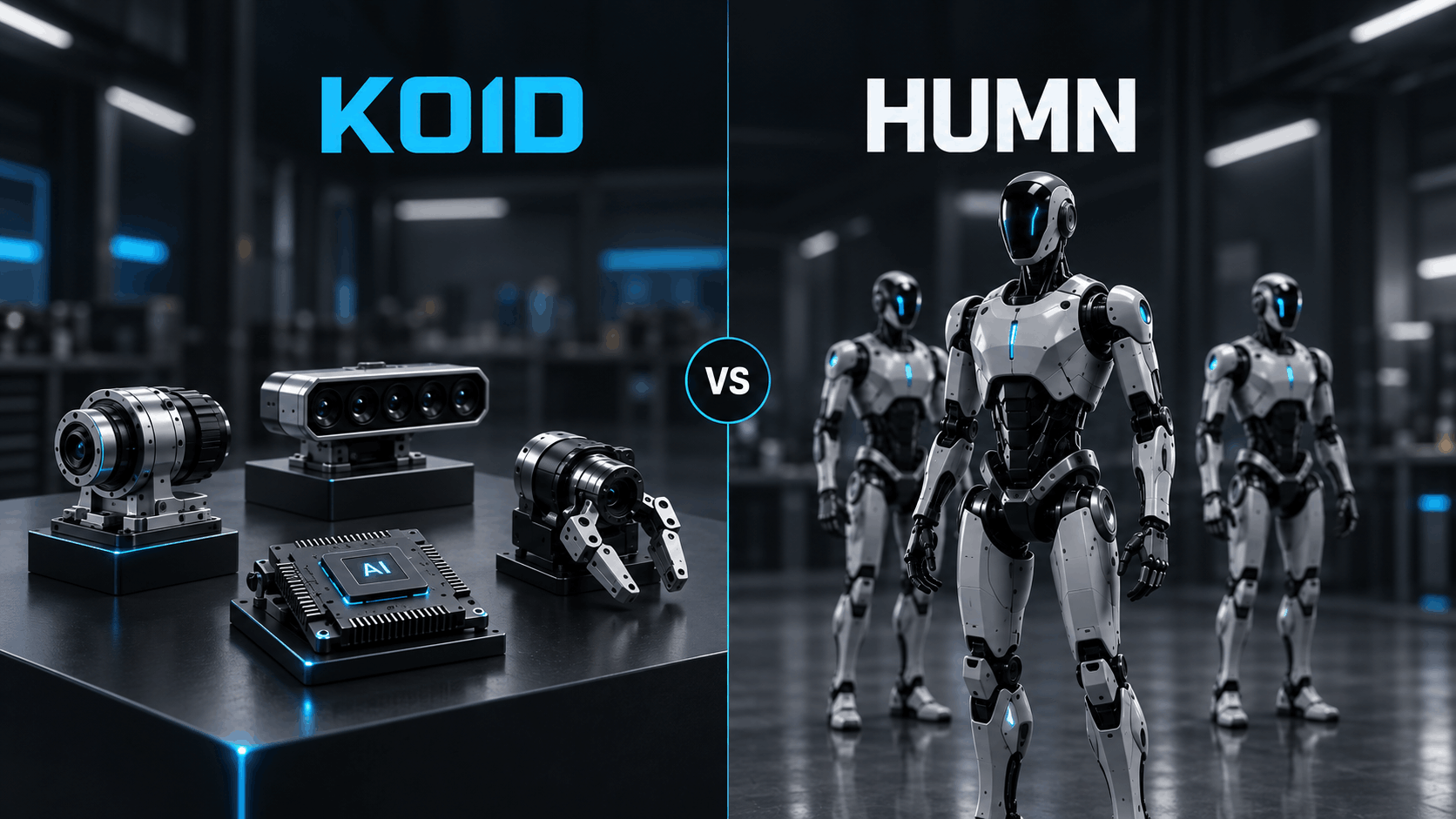
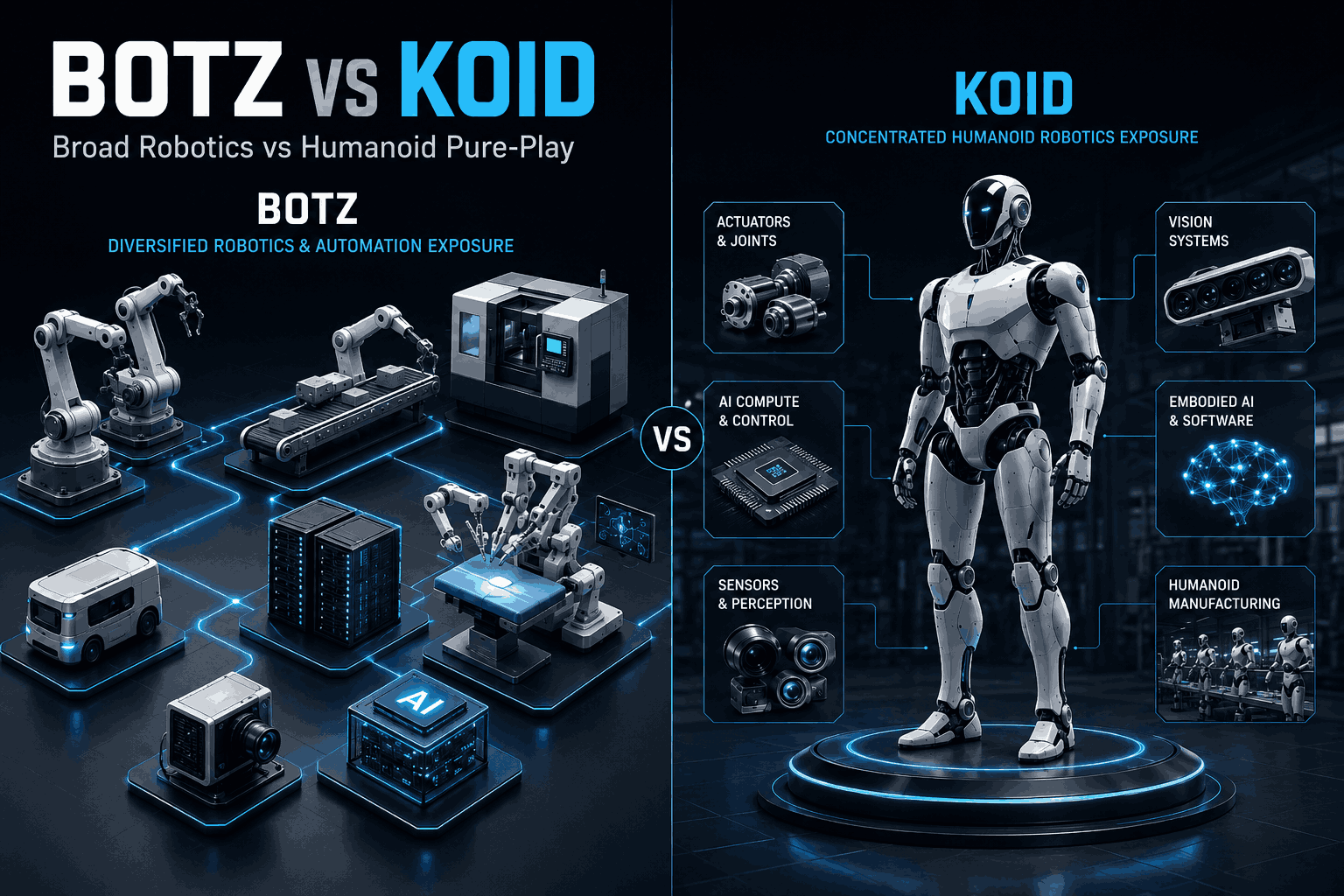
BOTZ and KOID answer two different investment questions inside the same robotics category. BOTZ, the Global X Robotics and Artificial Intelligence ETF, covers the broad automation economy. The fund has traded since September 2016 at a 0.68 percent expense ratio. KOID, the KraneShares Global Humanoid Robotics and Physical AI Index ETF, launched in 2025 as a bet on the humanoid supply chain. See exactly what KOID holds: our full KOID holdings breakdown.
BOTZ wins on track record, size, and diversification. KOID wins on focused humanoid supply-chain exposure that BOTZ only touches at the edges. The better fund depends on the question an investor is asking: broad robotics compounding or concentrated humanoid upside. The comparison below covers holdings, fees, strategy, and the investor profile each fund fits.
BOTZ vs KOID Comparison Table
The table below compares BOTZ and KOID on issuer, age, cost, strategy, and humanoid exposure.
| Attribute | BOTZ | KOID |
| Issuer | Global X | KraneShares |
| Full name | Global X Robotics & Artificial Intelligence ETF | KraneShares Global Humanoid Robotics and Physical AI Index ETF |
| Inception | September 2016 | 2025 |
| Expense ratio | 0.68 percent | 0.79% gross / 0.69% net |
| Index | Indxx Global Robotics & Artificial Intelligence Thematic Index | MerQube Global Humanoid Robotics and Physical AI Index |
| Holdings count | Approximately 40-plus | About 50-plus |
| Strategy | Broad robotics, AI, and industrial automation | Humanoid robotics pure-play |
| Humanoid exposure | Indirect, through diversified robotics and AI names | Focused, but only ~6% in humanoid makers |
| Assets under management | $3,382,218,884 | $327,489,824 |
| Track record | Nearly a decade through full market cycles | First full cycle still ahead |
Figures as of Sept. 2, 2026. For current fund data, see our Robotics ETF tracker.
What BOTZ Holds: The Broad Robotics Play
BOTZ tracks the Indxx Global Robotics and Artificial Intelligence Thematic Index and holds the established names of the automation economy.
Global X launched BOTZ in September 2016, which makes the fund one of the oldest and largest robotics ETFs available. The 0.68 percent expense ratio has held steady for years. The portfolio spans industrial automation, robotics, and artificial intelligence across roughly 40-plus companies.
BOTZ anchor holdings

The BOTZ anchor holdings read like the infrastructure layer of global automation.
NVIDIA supplies the compute. Intuitive Surgical dominates surgical robotics. ABB, Fanuc, and Keyence run the factory automation backbone, with heavy Japanese industrial exposure across the book. The fund owns the companies that sell the picks and shovels of the robot economy rather than betting on any single robot form factor. Humanoid exposure exists inside BOTZ only through these diversified names, never as the organizing thesis.
What KOID Holds: The Humanoid Supply Chain
KOID exists for one thesis: exposure to the supply chain behind the humanoid robot economy.
KraneShares launched KOID in 2025 as the humanoid buildout moved from research labs into factories. The fund concentrates on companies with revenue or roadmap exposure to humanoid platforms, components, and the embodied intelligence layer. The thesis is narrow on purpose. Concentration is the product.
The humanoid exposure difference
The humanoid exposure difference is the entire reason this comparison exists.
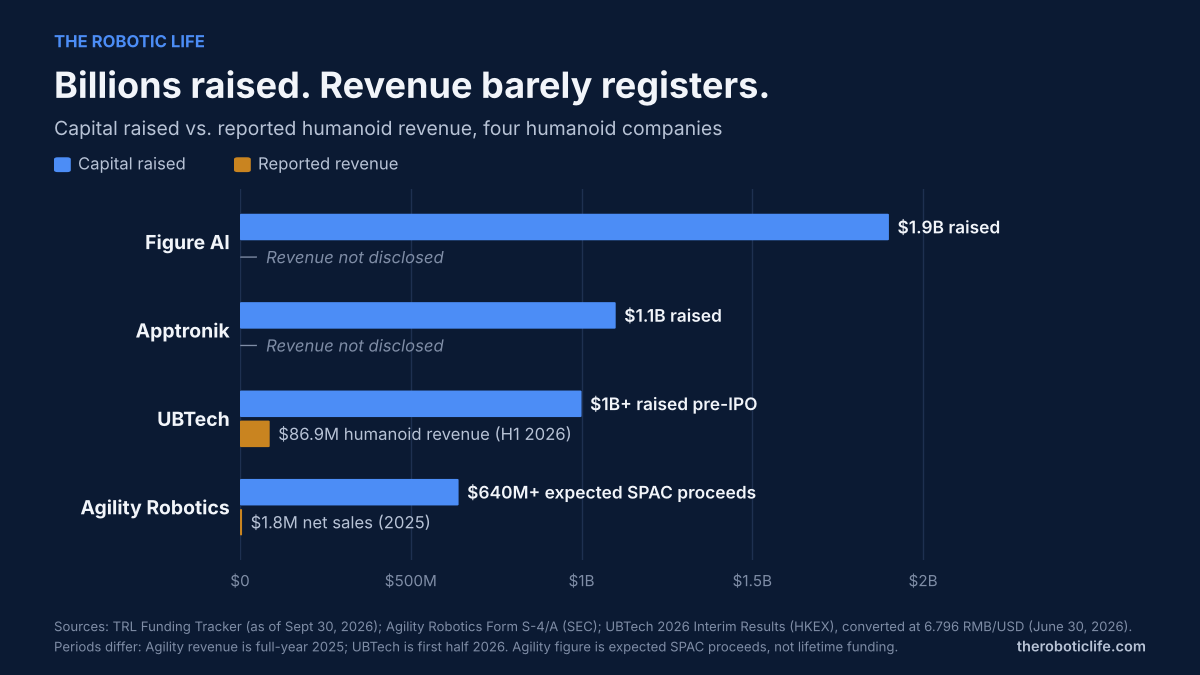
The public humanoid landscape runs through suppliers, manufacturers, and AI-layer companies rather than the private leaders. Figure AI at a $39 billion valuation stays private. Agility Robotics reaches public markets through the AGLT SPAC.
The investable humanoid universe today is actuator makers, sensor suppliers, compute providers, and the public manufacturers tracked in the humanoid robot directory. KOID packages that universe into one ticker. BOTZ dilutes it across the whole automation economy.
BOTZ vs KOID: The Strategy Difference That Decides the Choice

BOTZ is a diversification instrument and KOID is a conviction instrument, and no expense ratio changes that divide.
BOTZ spreads risk across the automation economy. A humanoid winter would dent the fund without breaking it, because surgical robotics, factory automation, and AI infrastructure carry the book. The cost of that safety is dilution. A humanoid boom lifts BOTZ modestly.
KOID concentrates risk on one category. A humanoid boom is the entire payoff scenario. A humanoid winter hits the whole portfolio at once, because concentration cuts both ways. Pure-play funds swing harder than diversified funds in both directions by design. Position sizing, not fund selection, is how investors manage that volatility difference in practice.
Performance between the two funds tracks the humanoid news cycle. Production milestones from Tesla, Figure, and the companies ranked in the top humanoid robot startups of 2026 move KOID directly and BOTZ at the margin. Live performance figures sit on the issuer pages and change daily, so this comparison stays anchored to structure rather than a snapshot.
BOTZ vs KOID on Fees, Size, and Liquidity
BOTZ carries the size and liquidity advantages of a 2016 fund, while KOID carries the tracking precision of a 2025 thesis.
BOTZ ranks among the largest robotics ETFs with nearly a decade of trading history and deep liquidity. The 0.68 percent expense ratio buys a proven wrapper. Tight spreads and high daily volume matter for anyone trading in size or running regular contributions. KOID trades as a newer, smaller fund, which typically means wider spreads and a shorter record.
New funds earn their liquidity as assets grow, and humanoid category attention is the growth driver KOID is built to catch. Fee-sensitive investors compare the confirmed expense ratios on the issuer pages on the day they buy, because ratios and waivers change.
Which ETF Fits Which Investor
BOTZ fits the investor who wants robotics exposure without category risk, and KOID fits the investor with a specific humanoid conviction.
Choose BOTZ for a core robotics allocation held through cycles. The fund rewards patience with diversification, an established record, and the infrastructure names that win regardless of which robot form factor dominates.
Choose KOID for a satellite position expressing a direct humanoid thesis. The fund rewards being right about the humanoid decade and punishes being early or wrong, because concentration amplifies both outcomes.
Holding both is a coherent structure. BOTZ as the core, KOID as the conviction satellite. The split expresses broad exposure with a measured humanoid tilt, sized to the investor’s risk tolerance. The full fund landscape sits in the top autonomous robot ETFs of 2026 guide.
Where HUMN Fits in the BOTZ vs KOID Question
HUMN, the Roundhill Humanoid Robotics ETF, gives the comparison a third option inside the pure-play lane.
Investors comparing KOID and HUMN are choosing between two humanoid pure-plays built in opposite ways: KOID tracks an equal-weighted index, while HUMN’s Investment Committee picks and sizes every position. The BOTZ decision stays the same in either pairing: broad automation or humanoid concentration. The KOID versus HUMN decision comes down to index construction, fees, and holdings overlap, which deserves its own dedicated breakdown. The full ETF lineup with all eleven tracked funds sits in the robotics investing hub.
Key Takeaways: BOTZ vs KOID
BOTZ and KOID solve different problems inside robotics investing. BOTZ delivers broad automation exposure through the Indxx index at a 0.68 percent expense ratio with a record running since September 2016. KOID delivers focused humanoid supply-chain exposure through a 2025 KraneShares wrapper built for the humanoid decade.
BOTZ wins on diversification, size, and history. KOID wins on thesis purity. The core-and-satellite structure holds both, sized to conviction. Confirm live figures on the issuer pages before any purchase, because expense ratios, holdings, and assets change.
Frequently Asked Questions
Is BOTZ or KOID better?
Neither fund is better in absolute terms because each answers a different question. BOTZ is better for diversified robotics exposure with a long track record. KOID is better for focused exposure to the humanoid supply chain, though only about 6% of the fund sits in companies that build humanoid robots.
What is the difference between BOTZ and KOID?
BOTZ is the Global X Robotics and Artificial Intelligence ETF, launched September 2016, covering broad automation at a 0.68 percent expense ratio. KOID is the KraneShares Global Humanoid Robotics and Physical AI Index ETF, launched 2025, focused on the humanoid supply chain: the chips, actuators and sensors that humanoids need.
Does BOTZ hold humanoid robotics stocks?
BOTZ holds humanoid exposure only indirectly through diversified robotics and AI names such as NVIDIA and the industrial automation majors. Humanoid robotics is never the fund’s organizing thesis.
What does KOID invest in?
KOID invests in about 50 companies across the humanoid supply chain. As of September 2026, about half the fund is in physical components like actuators, motors and sensors, and about 19% is in chips and AI computing. Only about 6% is in companies that build humanoid robots. See our full KOID holdings breakdown.
Is there a Vanguard humanoid robotics ETF?
No. Vanguard does not offer a humanoid robotics ETF. The humanoid-focused options in the category are funds such as KOID and HUMN. Broad funds such as BOTZ cover robotics and AI without a humanoid focus.
Disclaimer
The Robotic Life provides informational coverage of robotics companies, funds, and industry developments. Nothing in this article constitutes investment advice, a recommendation, or an offer to buy or sell any security. Fund figures change; confirm all data on the official issuer pages before making decisions. Readers considering financial decisions should consult a qualified financial advisor.
Sources
- Global X, BOTZ fund page: expense ratio, inception, and index methodology
- Indxx, Global Robotics & Artificial Intelligence Thematic Index
- KraneShares, KOID fund page: strategy and holdings
- Roundhill Investments, HUMN fund page: fund details
- Agility Robotics, SPAC announcement (June 24, 2026): AGLT listing path