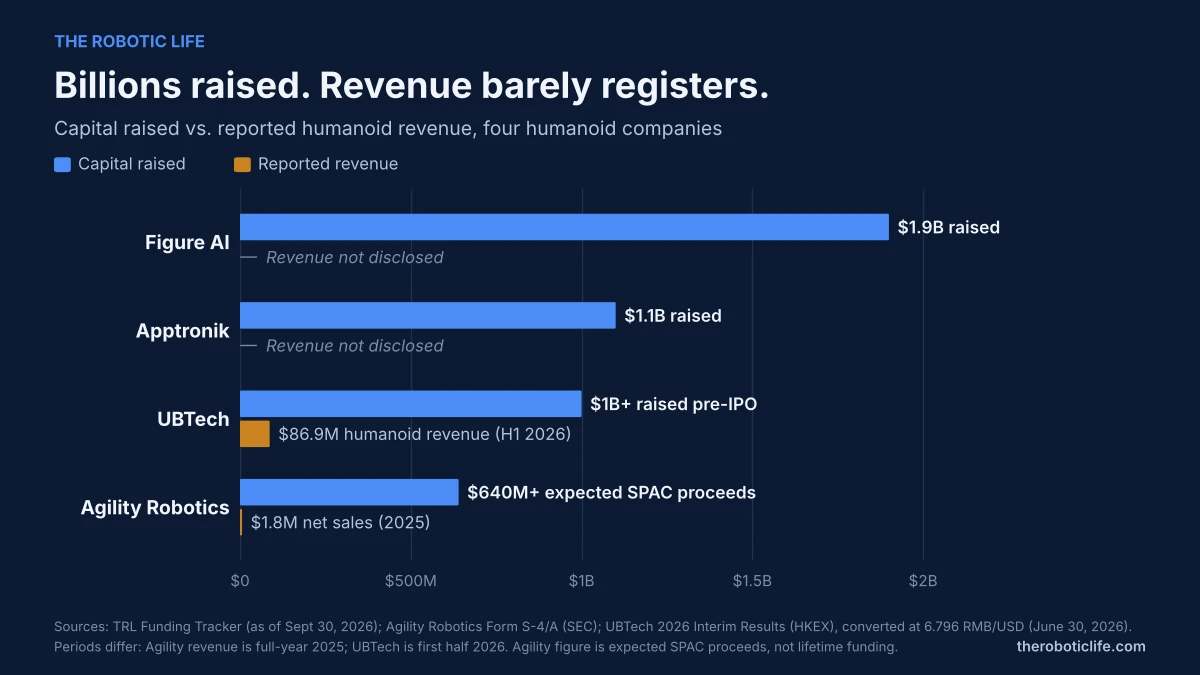
With Churchill Capital Corp XI shareholders scheduled to vote on its proposed merger with Agility Robotics on November 2, 2026, investors have a recent example to examine: Unitree Robotics’ volatile debut on China’s STAR Market. Unitree’s shares surged on their first trading day before falling sharply over the following weeks. The reversal offers a useful look at how public markets can price expectations for humanoid robotics.
Agility is pursuing a different route to the public markets through a merger with Churchill Capital Corp XI. If the transaction closes, the combined company expects to trade on Nasdaq under the ticker AGLT. The merger remains subject to shareholder approval and other closing conditions. The SEC-filed transaction announcement confirms the November 2 vote and the registration statement’s October 13 effectiveness.
Unitree’s trading history offers a lesson in volatility, but it is not a forecast for Agility. The more relevant measures for AGLT will be the cash available at closing, the conversion of orders into revenue, customer deployments, and the company’s path toward sustainable economics.
Unitree’s IPO Ride: From a Spectacular Debut to a Sharp Reset
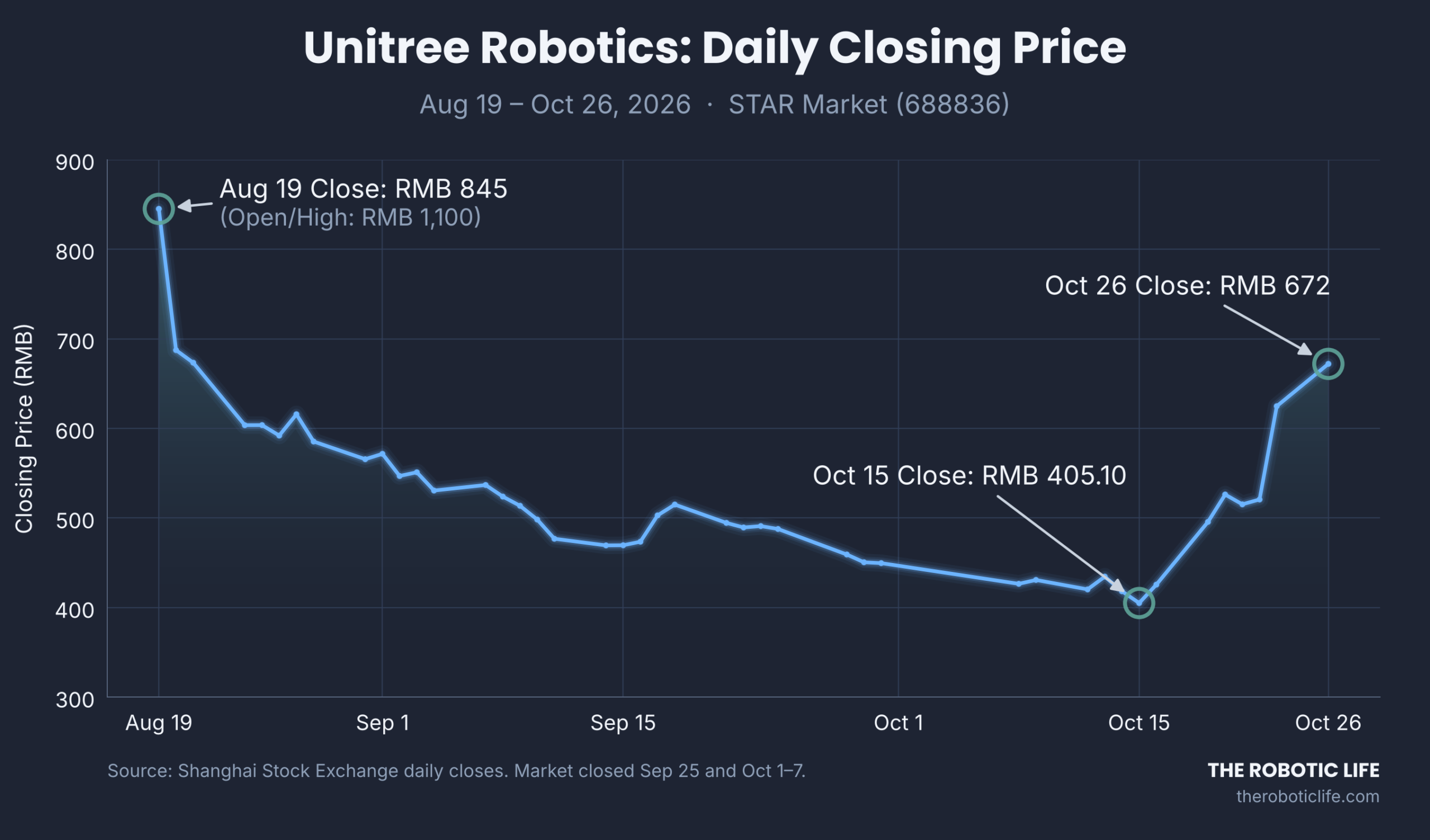
Unitree’s share-price history shows how far an IPO debut can move ahead of the underlying business, then retreat as trading continues. The stock remains well above its offering price, but the decline from its first-day high has been substantial.
The IPO Price Set the Starting Point, Not the Market’s Final Verdict
Unitree priced its shares at RMB 150.80 before listing on the Shanghai Stock Exchange’s STAR Market on August 19, 2026. The shares opened at RMB 1,100, a gain of approximately 629% over the offering price. They then closed at RMB 845, leaving the stock up about 460% on its first day. The closing price valued the company at roughly RMB 342 billion, according to the South China Morning Post’s report on the debut.
The gap between the opening and closing prices matters. The opening price captured the initial rush to buy shares. The close showed that some of that demand had already faded by the end of the session.
Demand for the shares was unusually high. That same report indicated that 9.8 million retail investment accounts vied for about 9.7 million shares. That imbalance helps explain the scale of the initial move, although heavy demand does not establish what a company is worth over the long term.
The Sell-Off Reset Expectations After the Initial Surge
The subsequent decline showed how quickly that initial valuation could change. Unitree’s shares reached an intraday low of RMB 404.03 on October 15, down approximately 63% from the first-day opening price and 52% from the first-day close. The stock closed that day at RMB 405.10.
The shares later recovered. Investing.com’s October 26 historical-price feed reported a closing price of RMB 672.00. That left the stock about 39% below its first-day opening price, but approximately 346% above its IPO price. The decline therefore erased a substantial part of the initial market premium without wiping out the gain over the offering price.
The share-price reversal also needs to be considered alongside Unitree’s financial performance. According to the Shanghai Stock Exchange’s published IPO information, revenue rose from RMB 392.77 million in 2024 to approximately RMB 1.70 billion in 2025. Unitree reported net profit of RMB 278.21 million for 2025, while net profit excluding non-recurring items was RMB 590.75 million. Reported profit was lower largely because of non-recurring charges, including a large one-time share-based payment expense, so the two figures measure profitability on different bases.
Those results provide evidence of a growing business with positive earnings. They do not, on their own, establish what investors should pay for its shares. The key lesson is that strong operating results and a sharp valuation reset can occur at the same time. For Agility, the question is whether its commercial progress and financial position can support the valuation attached to its proposed public listing.
Why Unitree Is an Imperfect Preview of Agility
Unitree’s debut offers a useful example of how investors price a humanoid robotics company. However, its experience cannot be transferred directly to Agility Robotics. The two companies face different trading environments, are entering public markets through different routes, and have different financial profiles.
1. The STAR Market and Nasdaq Create Different Trading Environments
Unitree’s listing took place on China’s STAR Market, where its IPO attracted extraordinary demand from retail investors. Nearly 9.8 million accounts competed for approximately 9.7 million shares in the online allocation. The final allocation rate was just 0.018%, or roughly one successful application in every 5,500. Under the process described by the South China Morning Post, successful applicants received a lot of 500 shares, with winners selected at random.
The STAR Market also has specific trading rules. The Shanghai Stock Exchange permits trading without daily price limits during the first five trading days after an IPO. Its rules then impose a 20% daily price limit. These arrangements helped shape the conditions under which Unitree began trading.
Agility expects to trade on Nasdaq after its proposed merger with Churchill Capital Corp XI closes. Its shares will face a different investor base and trading environment, including U.S. institutional investors, public-market liquidity, and ongoing financial disclosures. That does not mean Nasdaq trading will be less volatile. It means Agility’s valuation will develop under different market conditions.
2. A Priced IPO Is Not the Same as a SPAC Merger
Unitree set an IPO price before its shares began trading. Agility is pursuing a different route through a merger with Churchill Capital Corp XI.
The June 2026 transaction announcement set Agility’s pre-money equity valuation at $2.5 billion. It also outlined more than $620 million in expected gross transaction proceeds, including approximately $200 million in committed private investment in public equity (PIPE) financing.
These are announced transaction terms, not guaranteed final proceeds. The cash available to the combined company will depend on shareholder redemptions, financing, transaction expenses, and the merger’s closing conditions. The $2.5 billion pre-money equity valuation also differs from enterprise value and the market capitalization that will emerge once the shares trade publicly.
Investors should therefore assess Agility’s final capital position separately from its agreed transaction valuation.
3. Unitree’s Profitability Changes the Comparison
Unitree’s reported 2025 profitability gives investors a financial baseline that differs from Agility’s reported operating losses.
For Unitree:
Unitree entered public markets with an established revenue base and positive annual net profit. Its 2025 revenue reached RMB 1.70 billion, while reported net profit was RMB 278.21 million. Its financial performance provides a different starting point from Agility’s early commercial business.
For Agility:
Agility’s September 30, 2026, amended SEC registration statement reports a $138 million net loss for 2025, compared with $70.5 million in 2024. It also reported $105 million in cash, cash equivalents, and restricted cash at the end of 2025.
These losses reflect the costs of developing Digit, expanding manufacturing capacity, and preparing for broader commercial deployment. Agility must turn customer commitments into delivered robots and recognized revenue while managing production and servicing costs. Unitree’s profitability does not guarantee that its shares will hold their value. Equally, Agility’s losses do not determine its future market valuation. The more relevant question is whether Agility can convert commercial demand into sustainable revenue and improve its operating economics.
Unitree vs. Agility: What the Numbers Actually Show
Unitree and Agility are entering public markets from different financial positions. Unitree reported meaningful revenue and a net profit in 2025. Agility has active commercial deployments and more than $300 million in contracted multiyear Digit 5 orders, but it remains at an earlier stage of revenue generation. The figures below use Unitree’s IPO disclosures and Agility’s latest SEC registration statement and company announcements available as of October 26, 2026.
| Metric | Unitree Robotics | Agility Robotics |
| Exchange | Shanghai Stock Exchange, STAR Market | Nasdaq expected, subject to merger closing |
| Listing route | Conventional IPO, August 19, 2026 | SPAC merger with Churchill Capital Corp XI |
| Valuation | IPO price of RMB 150.80 per share; market value changes with the share price | $2.5 billion pre-money equity valuation under the proposed merger |
| Revenue | RMB 1.70 billion in 2025 | $1.78 million in 2025; $174,000 in H1 2026 |
| Profitability | RMB 278.21 million reported net profit in 2025; RMB 590.75 million excluding non-recurring items | $138 million net loss in 2025 |
| Commercial scale | More than 5,500 humanoid robots shipped in 2025, according to its IPO materials | Commercial deployments with customers including GXO, Schaeffler, and Toyota Motor Manufacturing Canada; more than 30 prospective customers reported on October 26, 2026 |
| Order visibility | Historical shipments and reported sales | More than $300 million in multiyear contracted Digit 5 orders, announced in June 2026 |
| Capital position | IPO proceeds intended for R&D, product development and manufacturing | More than $620 million in expected gross transaction proceeds, subject to closing conditions and redemptions |
The comparison needs context. Agility’s $300 million order figure represents contracted future business, not revenue already recognized. Its 2025 sales were also small relative to its operating costs. The proposed merger valuation therefore reflects expectations for future commercial growth, while Unitree’s public-market valuation applies to a business with a more established revenue base. Neither company’s valuation alone establishes what its shares should be worth.
What AGLT Investors Should Actually Watch
Unitree’s share price swings show why investors should look beyond an IPO headline. For Agility, the more useful indicators are the cash available after the merger, the conversion of contracted orders into revenue, and the cost of delivering robots at scale.
Redemptions and Cash at Closing Determine the Financial Starting Point
Agility’s cash after the merger will depend on shareholder redemptions, PIPE financing and transaction expenses. The latest SEC registration statement estimates approximately $576 million in cash after expenses under a no-redemption scenario. Under maximum redemptions, estimated net cash proceeds fall to about $155 million.
The merger includes a $200 million minimum cash condition. This is measured before transaction expenses and certain other deductions. Investors should monitor final redemptions, closing costs, available cash and the post-merger share count. These figures are illustrative scenarios and not final closing amounts.
Contracted Orders Must Become Delivered Robots and Recognized Revenue
Agility announced more than $300 million in multiyear contracted Digit v5 orders in June 2026. The company’s transaction materials describe these orders as subject to contractual milestones. They also identify customer deployments with GXO, Schaeffler, Toyota Motor Manufacturing Canada, and Mercado Libre.
On October 26, Agility reported more than 30 prospective customers and three additional manufacturing customers in paid programs. These figures show commercial interest, but prospective customers are not the same as contracted orders. Investors should watch how quickly Agility delivers robots and records revenue from its commitments.
Deployment Growth and Unit Economics Will Test the Commercial Model
Agility reported that Digit had moved more than 100,000 totes at GXO’s Georgia facility. GXO also announced plans to deploy Digit at two more U.S. facilities, with deployments expected to begin in early 2027.
Hence, investors should track deployment growth alongside manufacturing and service costs and operating cash burn. More deployments will strengthen the commercial case only if Agility can deliver robots reliably and generate repeat business.
Update (October 30, 2026): Unitree’s first quarterly report since its August listing sharpened the distinction between rapid revenue growth and near-term profitability. In its third-quarter filing, released on October 28 and reported on October 29, the company said revenue rose 69.93% year over year to RMB 665.04 million (about US$99.8 million), while net profit attributable to controlling shareholders fell 17.37% to RMB 112.69 million, roughly half the RMB 224 million analysts expected, according to Reuters estimates cited by Seoul Economic Daily. Research-and-development spending surged 249.58% to RMB 127 million, or 19% of revenue, as Unitree increased investment in embodied-AI models, computing resources, research staff, and new products. For the first nine months of 2026, revenue rose 55.71% to RMB 1.817 billion and attributable net profit increased 270.54% to RMB 387 million, a jump that partly reflects a large one-time share-based payment expense in the prior-year period; excluding one-time items, nine-month net profit fell about 18% year over year. The results reinforce the article’s central point: Unitree remains profitable and is scaling revenue, but rising R&D, selling expenses, and inventory are reshaping its earnings, whereas Agility’s public-market test will begin with cash burn, deployment execution, and whether it can satisfy its SPAC merger’s minimum-cash condition. Shares closed at RMB 647.05 on October 30, down 2.3% on the day, still about 329% above the IPO price but roughly 41% below the first-day open. Earlier that week, on October 26, JPMorgan upgraded the stock two notches to Overweight and raised its price target to RMB 995 from RMB 300, lifting shares nearly 8% that day. Sources: Seoul Economic Daily, Caixin, MarketScreener, Yahoo Finance.
Bottom Line
Unitree’s first-day close rose 460% above its IPO price. However, the shares later fell sharply from their debut high. This history shows how quickly market expectations can change. It does not establish that Agility will follow the same path.
Agility’s more relevant milestones are the SPAC’s closing conditions, cash available after redemptions and expenses, conversion of contracted orders into deployments, and progress toward sustainable unit economics. The central question is not whether AGLT can repeat Unitree’s debut. It is whether Agility can turn customer commitments and available capital into a commercially scalable business.
Related: Top 10 Humanoid Robot Companies & Startups by Funding 2026
Disclaimer: This article is for informational purposes only and is not investment advice.
Sources
- https://www.sec.gov/Archives/edgar/data/2074973/000121390026109058/ea0297114-07.htm
- https://english.sse.com.cn/news/newsrelease/voice/c/c_20260811_10828578.shtml
- https://www.scmp.com/tech/tech-trends/article/3364499/unitree-robotics-surges-629-us66-billion-valuation-shanghai-share-debut
- https://www.scmp.com/business/markets/article/3363998/chasing-robots-chasing-profits-numbers-moving-markets
- https://ph.investing.com/equities/yushu-tech-co-historical-data
- https://english.sse.com.cn/start/sserules/stocks/trading/c/10644064/files/7d100419dcca456b97cabaf2dfd3b904.pdf
- https://www.sec.gov/Archives/edgar/data/2074973/000121390026071287/ea029548401ex99-1.htm
- https://www.sec.gov/Archives/edgar/data/2074973/000121390026071287/ea029548401ex99-2.htm
- https://investors.gxo.com/news-releases/news-release-details/gxo-and-agility-robotics-expand-partnership-accelerate