Figures as of October 2026.
Humanoid robotics has attracted billions of dollars in capital, but reported revenue remains small or undisclosed for many of the companies receiving that funding. The Robotic Life’s Funding Tracker records $11.8 billion in disclosed capital raised across 26 tracked humanoid companies, excluding internally funded corporate programs. The investor question is what portion of that capital has turned into actual sales.
That requires separating several metrics that are often presented together. Funding measures capital committed by investors. Orders and backlog indicate potential future sales. Pilots and deployments show that robots are operating with customers. Recognized revenue is the accounting evidence that a sale has occurred.
This analysis examines the gap between humanoid robotics funding and reported revenue, using company disclosures and public filings where available, and identifies the commercial milestones that could begin closing it.
The Funding Has Arrived. Revenue Has Not Kept Pace
The Funding Tracker’s $11.8 billion industry funding figure shows how strongly investors are underwriting humanoid robotics. The largest total raised by a single company is $1.9 billion, and three tracked companies are now public. The total leaves out internally funded programs. The tracker counts those separately, at more than $30 billion across Tesla and Xiaomi.
Figure AI is the best-funded private company on the list, at about $1.9 billion. The tracker also lists 1X Technologies at more than $250 million. Apptronik described its total as nearly $1 billion in February 2026; the tracker now shows $1.1 billion.
The largest financing announcements reinforce the scale of investor expectations. Figure announced in September 2025 that it had exceeded $1 billion in committed capital in its Series C, at a $39 billion post-money valuation. The company said the financing would support humanoid production, its Helix AI platform, data collection and expansion into commercial environments.
Apptronik’s February 2026 announcement provides another useful benchmark. The company first raised a $415 million Series A in 2025, then added a $520 million Series A-X extension in February 2026. That took the total Series A to more than $935 million and total capital raised to nearly $1 billion. The company mentions that this capital would support production and deployment of its Apollo humanoid robot.
Funding measures investor commitment to future humanoid robot commercialization. It does not measure current demand or profitability. Valuation is a third number again. Figure’s $39 billion valuation rests on a round of just over $1 billion.
That distinction becomes clearer when the companies’ commercial activity is compared with the financial information that is actually available.
Four Companies Show How Wide the Humanoid Robotics Revenue Gap Can Be
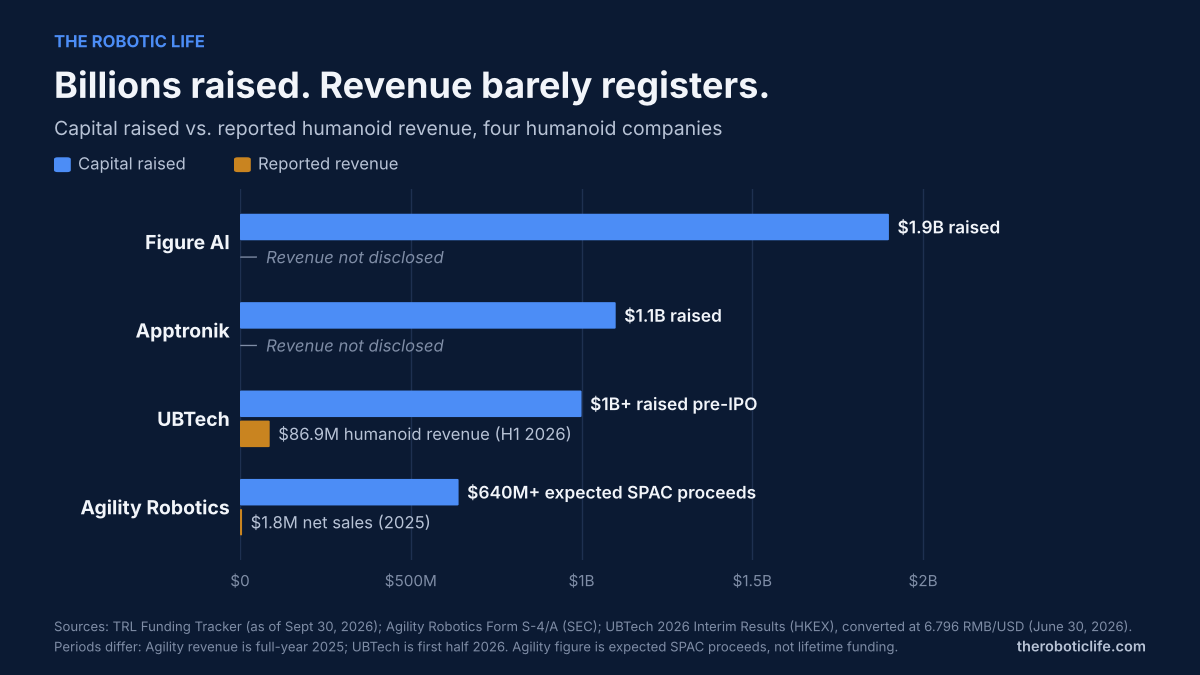
The gap between humanoid robotics funding and revenue looks different across companies. Some have raised billions and moved into real-world humanoid robot deployments without disclosing revenue. Others can point to substantial backlogs or customer partnerships.
These case studies show why funding, orders, deployments and revenue need to be evaluated separately.
1. Figure AI: Heavy Funding, Commercial Deployments, Revenue Not Disclosed
Figure AI has become the clearest example of the sector’s funding versus revenue gap. Its Series C round of more than $1 billion, at a $39 billion post-money valuation, makes it one of the best-funded private humanoid robot companies.
It also has real-world operational evidence. BMW said that over ten months, Figure 02 worked approximately 1,250 hours at BMW Group Plant Spartanburg and supported the production of more than 30,000 BMW X3 vehicles. Those are company-reported deployment figures. They show that a humanoid robot operated within a live automotive production environment. However, they do not disclose how much BMW paid or whether the relationship has generated recurring sales at scale.
Figure has also announced additional commercial agreements, including a relationship with Catalyst Brands. These agreements may broaden the pipeline for future deployments. But a customer agreement is not the same as recognized humanoid robotics revenue.
Investor takeaway: Figure has clear evidence of commercial activity. However, it does not publicly disclose a humanoid revenue figure that allows investors to measure how much of its funding has been converted into humanoid robot sales.
2. Apptronik: Nearly $1B Raised Before Scale-Up
Apptronik has followed a similar funding-heavy path. Its initial $415 million Series A was expanded to more than $935 million through a $520 million extension announced in February 2026. The company described total capital raised as nearly $1 billion.
The capital is being used to move Apollo toward scaled production and commercial deployment. Apptronik has established relationships with companies including Mercedes-Benz, GXO and Jabil. This gives Apollo exposure to manufacturing, logistics and other industrial environments.
These relationships provide useful customer validation. They should not be treated as humanoid robotics revenue unless the associated financial results are disclosed.
The distinction is important because Apptronik’s own funding announcement frames the new capital around production and commercial or pilot deployments. That means the company is still converting technical capability and customer interest into a repeatable commercial operation.
Investor takeaway: Apptronik is moving from technical development toward commercialization, but the important test is whether customer pilots and deployments turn into repeatable paid volume.
3. Agility Robotics: Backlog Is Not Revenue
Agility Robotics provides the clearest public financial view of the gap between humanoid demand claims and current revenue.
Its 2026 SEC-filed S-4/A disclosed $1.8 million in 2025 net sales against an approximately $140 million operating loss. The filing also describes Agility as an early-stage company that expects operating losses and negative cash flow to continue as it develops and scales Digit.
That is a small revenue base compared with the company’s reported commercial pipeline. Agility has reported more than $300 million in multi-year Digit v5 orders, tied to a single customer. The order value is expected to be realized over time, subject to contractual milestones, and is not a measure of current-period revenue. Agility has also described deployments across multiple customer facilities. The merger values Agility at $2.5 billion and includes approximately $200 million in PIPE financing, according to the SEC filing.
Investor takeaway: These numbers show why investors should look beyond the backlog. The company is also moving further into commercial deployment than many early-stage competitors. However, its recognized revenue remains tiny relative to its operating costs.
4. UBTECH: The Exception With Reported Humanoid Revenue
UBTECH provides a different picture because its financial reporting gives investors a direct view of humanoid revenue.
In its 2026 interim report filed with the Hong Kong Stock Exchange, UBTECH reported RMB590.3 million (about $86.9 million) in revenue from full-size embodied intelligent humanoid robot products and services for the first half of 2026. That is up 1,445% from RMB38.2 million (about $5.6 million) a year earlier. Dollar figures are converted at 6.796 RMB per U.S. dollar, the June 30, 2026 rate. Sales volume reached 921 units, up 1,946.7% year over year.
The 1,445% figure is revenue growth, while 1,946.7% is unit growth. The two should not be treated as interchangeable measures of commercial performance.
UBTECH’s broader business remains loss-making. Its total operating loss in the first half of 2026 was RMB279.1 million (about $41.1 million), and its loss for the period was RMB338.8 million (about $49.9 million).
That makes UBTECH useful as an exception rather than proof that the sector has solved its economics. It also shows that humanoid robotics revenue can become measurable at commercial scale and why revenue alone is insufficient.
Investor takeaway: UBTECH shows that humanoid robotics can be a meaningful revenue stream. But investors will need to decide whether that business can become profitable and reduce its cash burn.
Orders, Pilots and Shipments Are Not the Same as Revenue
From the investors’ point of view, the most significant difference is between the evidence of commercial interest and the evidence of earned revenue. Even before these activities are reflected as a sale, humanoid companies can have partnerships, pilots, customer orders and expanding backlogs to show that they are on the right track.
| Signal | What it proves | What it does not prove |
| Partnership or MOU | Strategic interest | Customer payment |
| Pilot | Technical and customer validation | Repeatable commercial demand |
| Announced order | Contracted demand, if binding | Recognized revenue today |
| Backlog | Potential future contracted sales | Cash already earned |
| Shipment | Physical delivery | Profitability |
| Recognized revenue | Accounting evidence of sales | Sustainable unit economics |
This framework changes how several of the sector’s biggest announcements should be interpreted.
- Figure’s BMW pilot is meaningful because a humanoid robot operated in a real production environment for 1,250 hours. But BMW’s operating statistics are evidence of deployment and not a Figure revenue disclosure.
- Apptronik’s relationships with Mercedes-Benz, GXO and Jabil show that Apollo is being tested and positioned for real industrial applications. They do not establish the value or timing of recognized sales.
- Agility’s more than $300 million of humanoid robot orders are more directly commercial, but the company’s S-4 makes the financial distinction visible. The business recorded only $1.8 million in 2025 net sales.
- UBTECH is the stronger example of what investors ultimately need to see. Its interim filing reports humanoid robotics revenue directly attributable to full-size humanoid products and services, alongside the associated unit sales.
The industry is moving from demonstrations toward commercial deployments. For most private companies, the revenue conversion rate remains the unanswered question.
What Has to Happen for the Funding-Revenue Gap to Close?
Closing the gap between funding and revenue depends on four measurable variables:
- Robot selling price: Customers need a price they can justify against the cost of human labor or automation. The Robotic Life directory provides useful market context with listed estimates. These include Tesla’s stated target of $20,000-$30,000 for Optimus, $20,000 or $499 per month for 1X NEO, and an estimate of less than $50,000 for Apollo. These are estimates or listed pricing and not evidence of completed transaction prices.
- Unit manufacturing cost: If every robot is still a high-cost item, a high selling price will not make a good business. In early 2024, Goldman Sachs Research estimated humanoid manufacturing costs at $30,000 to $150,000 per unit. Whether humanoid companies achieve revenue growth to sustainable gross margins will depend on scale and the efficiency of components and manufacturing.
- Utilization and deployment volume: The economics of a robot that has a value for several hours a day are different from those that operate across multiple shifts. For companies to achieve profitable returns on customer usage of their hardware purchases, they must have an adequate number of units deployed and high utilization.
- Recurring revenue: Robots-as-a-service, leasing, maintenance and software can provide a better revenue base than one-time hardware sales. That might also be better suited to the economics of the provider and the productivity of the customer.
Long-term forecasts show the potential scale of the market. However, they should not be confused with current revenue. Goldman Sachs Research’s 2024 base case projected more than 250,000 humanoid shipments in 2030 and a global market reaching $38 billion by 2035. The forecast assumes continuous reductions in component costs among other factors.
The key question for investors is whether higher utilization and repeat purchases can turn capital intensive deployments into durable revenue streams.
What Investors Should Watch Next
The humanoid robotics investment case is moving into a more demanding phase. Funding remains a strong signal of investor conviction, but it says less about present commercial performance than it did when most companies were still developing prototypes.
Investors should focus on:
- Recognized revenue: How quickly are deployments converting into reported sales?
- Delivered units: How many robots are actually reaching customers?
- Realized selling prices: What are customers actually paying per robot or deployment?
- Unit economics: Are manufacturing, servicing and deployment costs falling fast enough to support sustainable margins?
- Repeat deployments: Are customers expanding orders after initial pilots and deployments?
- Revenue growth versus capital consumption: Is commercial growth beginning to justify the amount of capital being invested?
The revenue gap does not invalidate the humanoid robotics thesis. It shows where the sector stands. Investors are still underwriting future manufacturing scale and robot economics rather than a mature revenue stream. The next phase will be judged by how much of the capital already raised can be converted into durable and recurring sales.
Want the data behind this analysis? Download The Robotic Life’s free 2026 Humanoid Robotics Funding Report for company-by-company funding, valuations and deployment stages.
Disclaimer: This article is for informational purposes only and is not investment advice.
Source Log
| # | Claim | Source | URL | Date accessed |
| 1 | Humanoid robotics funding: $11.8 billion across 26 tracked companies | The Robotic Life, Funding Tracker | https://theroboticlife.com/robotics-funding-tracker/ | Oct 9, 2026 |
| 2 | More than $30 billion in internally funded corporate programs across Tesla and Xiaomi, tracked separately from the $11.8 billion total | The Robotic Life, Funding Tracker | https://theroboticlife.com/robotics-funding-tracker/ | Oct 9, 2026 |
| 3 | Figure AI has raised approximately $1.9 billion in total funding | The Robotic Life, Funding Tracker | https://theroboticlife.com/robotics-funding-tracker/ | Oct 9, 2026 |
| 4 | 1X Technologies has raised more than $250 million | The Robotic Life, Funding Tracker | https://theroboticlife.com/robotics-funding-tracker/ | Oct 9, 2026 |
| 5 | Figure AI raised more than $1 billion in Series C funding | Figure AI, Series C announcement | https://www.figure.ai/news/series-c | Oct 9, 2026 |
| 6 | Figure AI reached a $39 billion post-money valuation | Figure AI, Series C announcement | https://www.figure.ai/news/series-c | Oct 9, 2026 |
| 7 | Apptronik raised a $520 million Series A-X extension | Apptronik, February 2026 funding announcement | https://apptronik.com/news-collection/apptronik-closes-over-935-million-series-a | Oct 9, 2026 |
| 8 | Apptronik’s initial $415 million Series A and extension brought its total Series A funding above $935 million | Apptronik, February 2026 funding announcement | https://apptronik.com/news-collection/apptronik-closes-over-935-million-series-a | Oct 9, 2026 |
| 9 | Apptronik reported nearly $1 billion in total capital raised | Apptronik, February 2026 funding announcement | https://apptronik.com/news-collection/apptronik-closes-over-935-million-series-a | Oct 9, 2026 |
| 10 | Figure 02 worked approximately 1,250 hours during its BMW deployment, according to BMW | BMW Group, humanoid robot deployment announcement | https://www.press.bmwgroup.com/united-kingdom/article/detail/T0455870EN_GB/bmw-group-to-deploy-humanoid-robots-in-production-in-germany-for-the-first-time | Oct 9, 2026 |
| 11 | Figure 02 supported production involving more than 30,000 BMW X3 vehicles, according to BMW | BMW Group, humanoid robot deployment announcement | https://www.press.bmwgroup.com/united-kingdom/article/detail/T0455870EN_GB/bmw-group-to-deploy-humanoid-robots-in-production-in-germany-for-the-first-time | Oct 9, 2026 |
| 12 | Figure AI announced a commercial agreement with Catalyst Brands | Figure AI, Catalyst Brands agreement | https://www.figure.ai/news/figure-signs-agreement-with-catalyst-brands | Oct 9, 2026 |
| 13 | Agility Robotics reported $1.8 million in 2025 net sales | Churchill Capital Corp XI / Agility Robotics, Form S-4/A, SEC | https://www.sec.gov/Archives/edgar/data/2074973/000121390026105334/ea0297114-05.htm | Oct 9, 2026 |
| 14 | Agility Robotics reported approximately $140 million in operating losses | Churchill Capital Corp XI / Agility Robotics, Form S-4/A, SEC | https://www.sec.gov/Archives/edgar/data/2074973/000121390026105334/ea0297114-05.htm | Oct 9, 2026 |
| 15 | Agility Robotics secured more than $300 million in multi-year contracted Digit orders, subject to contractual terms | Churchill Capital Corp XI / Agility Robotics, transaction announcement filed with the SEC | https://www.sec.gov/Archives/edgar/data/2074973/000121390026071287/ea029548401ex99-1.htm | Oct 9, 2026 |
| 16 | Agility Robotics’ proposed transaction valued the company at $2.5 billion | Churchill Capital Corp XI / Agility Robotics, transaction announcement filed with the SEC | https://www.sec.gov/Archives/edgar/data/2074973/000121390026071287/ea029548401ex99-1.htm | Oct 9, 2026 |
| 17 | The Agility Robotics transaction included approximately $200 million in incremental PIPE financing | Churchill Capital Corp XI / Agility Robotics, transaction announcement filed with the SEC | https://www.sec.gov/Archives/edgar/data/2074973/000121390026071287/ea029548401ex99-1.htm | Oct 9, 2026 |
| 18 | UBTECH reported RMB590.3 million in first-half 2026 revenue from full-size embodied intelligent humanoid robot products and services | UBTECH Robotics, 2026 Interim Results, HKEX | https://www1.hkexnews.hk/listedco/listconews/sehk/2026/0828/2026082801691.pdf | Oct 9, 2026 |
| 19 | UBTECH’s first-half 2026 full-size humanoid robot revenue grew 1,445% year over year | UBTECH Robotics, 2026 Interim Results, HKEX | https://www1.hkexnews.hk/listedco/listconews/sehk/2026/0828/2026082801691.pdf | Oct 9, 2026 |
| 20 | UBTECH sold 921 units in the relevant full-size humanoid robot category in the first half of 2026 | UBTECH Robotics, 2026 Interim Results, HKEX | https://www1.hkexnews.hk/listedco/listconews/sehk/2026/0828/2026082801691.pdf | Oct 9, 2026 |
| 21 | UBTECH’s first-half 2026 unit sales grew 1,946.7% year over year | UBTECH Robotics, 2026 Interim Results, HKEX | https://www1.hkexnews.hk/listedco/listconews/sehk/2026/0828/2026082801691.pdf | Oct 9, 2026 |
| 22 | UBTECH reported an operating loss of approximately RMB279.1 million in the first half of 2026 | UBTECH Robotics, 2026 Interim Results, HKEX | https://www1.hkexnews.hk/listedco/listconews/sehk/2026/0828/2026082801691.pdf | Oct 9, 2026 |
| 23 | UBTECH reported a loss for the period of approximately RMB338.8 million in the first half of 2026 | UBTECH Robotics, 2026 Interim Results, HKEX | https://www1.hkexnews.hk/listedco/listconews/sehk/2026/0828/2026082801691.pdf | Oct 9, 2026 |
| 24 | Listed price estimates for Tesla Optimus, 1X NEO and Apptronik Apollo; these are estimates, not verified transaction prices | The Robotic Life, humanoid robotics directory | https://theroboticlife.com/ | Oct 9, 2026 |
| 25 | Goldman Sachs projected more than 250,000 humanoid robot shipments in 2030 | Goldman Sachs Research, 2024 humanoid robotics forecast | https://www.goldmansachs.com/insights/articles/the-global-market-for-robots-could-reach-38-billion-by-2035.html | Oct 9, 2026 |
| 26 | Goldman Sachs projected a $38 billion humanoid robotics market by 2035 | Goldman Sachs Research, 2024 humanoid robotics forecast | https://www.goldmansachs.com/insights/articles/the-global-market-for-robots-could-reach-38-billion-by-2035.html | Oct 9, 2026 |
| 27 | Goldman Sachs estimated humanoid robot manufacturing costs at $30,000-$150,000 per unit in its 2024 research | Goldman Sachs Research, 2024 humanoid robotics forecast | https://www.goldmansachs.com/insights/articles/the-global-market-for-robots-could-reach-38-billion-by-2035.html | Oct 9, 2026 |