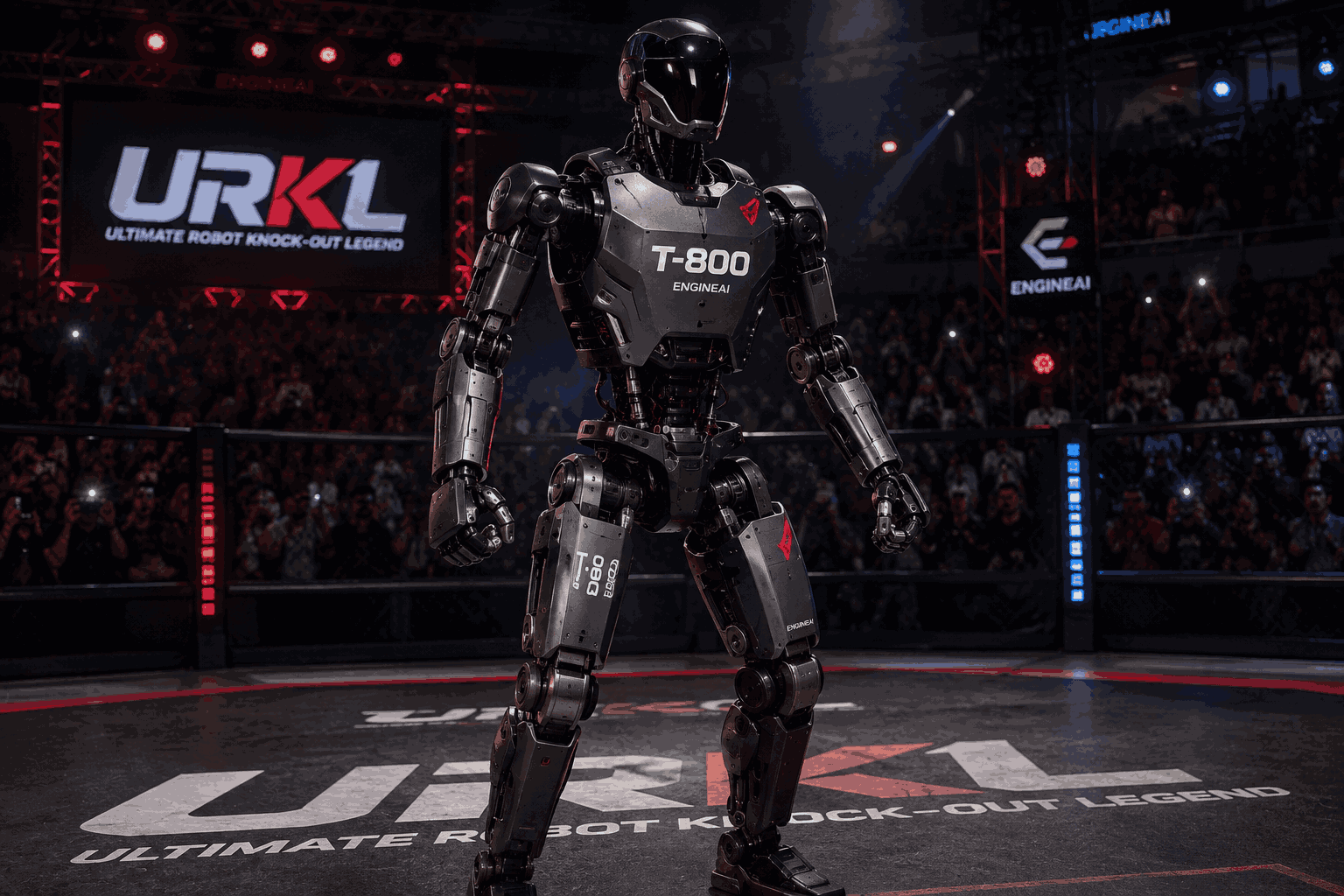
The EngineAI T-800 is the standardized platform behind URKL, the world’s first full-scale humanoid robot combat league. URKL opened on July 16, 2026 in Shenzhen with a viral moment. A robot named Matador lost its head to a high kick and kept fighting on backup torso sensors. The T-800 delivers 450 Newton meters of peak joint torque and starts at $25,000.
The platform runs the first solid-state battery in a production humanoid per EngineAI. Thirty-two teams worldwide compete on identical hardware, making software the only differentiator. EngineAI treats every fight as real-world stress-test data for its industrial roadmap. This Robot of the Week breakdown covers the league, the specifications, and the investment angle.

Why the EngineAI T-800 Is This Week’s Robot of the Week
The T-800 earns the Robot of the Week slot because the platform turned a viral decapitation into the most important stress-test dataset in humanoid robotics.
Last week covered Digit, the humanoid already earning a paycheck on the warehouse floor. The full breakdown sits in the Agility Digit Robot of the Week analysis. This week the series goes someplace completely different.
On July 16, 2026, URKL held its opening night in Shenzhen. A robot named White Eagle landed a high kick on its opponent, Matador. The head flew clean off. Matador kept fighting. No hesitation. No shutdown. A headless humanoid threw punches on backup torso sensors as if nothing happened.
The clip went viral for obvious reasons. The machine at the center of the moment matters more than the spectacle. That machine is the T-800 from EngineAI.
What URKL Is: The First Full-Scale Humanoid Combat League
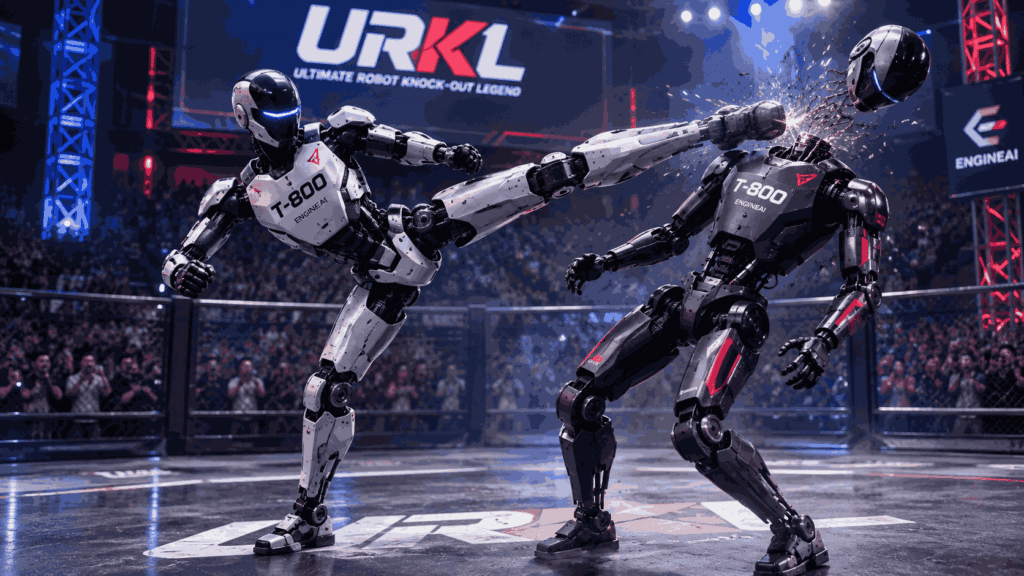
URKL, the Ultimate Robot Knock-out Legend, is a combat league founded by EngineAI where 32 teams worldwide compete on one standardized platform.
Every team receives identical T-800 hardware. The only differentiator is software: the control algorithms, the AI, and the training. The structure works less like a robot demolition derby and more like Formula 1. Same chassis. Different engineering teams racing to extract maximum performance from identical machines. The standardized format solves the credibility problem every robot demo faces. Nobody can claim a staged environment when 32 rival teams run the same hardware under the same rules in front of a live crowd.
The opening bout ran at the Nanshan Cultural and Sports Center in Shenzhen before a capacity crowd. White Eagle of Close Quarters Humanoid Combat traded kicks, uppercuts, and leg sweeps with Matador. The season champion takes home a 10-kilogram pure gold belt valued at $1.44 million per the league. This is not a science fair. This is a sport, and the T-800 was built for exactly this moment.
EngineAI T-800 Specifications
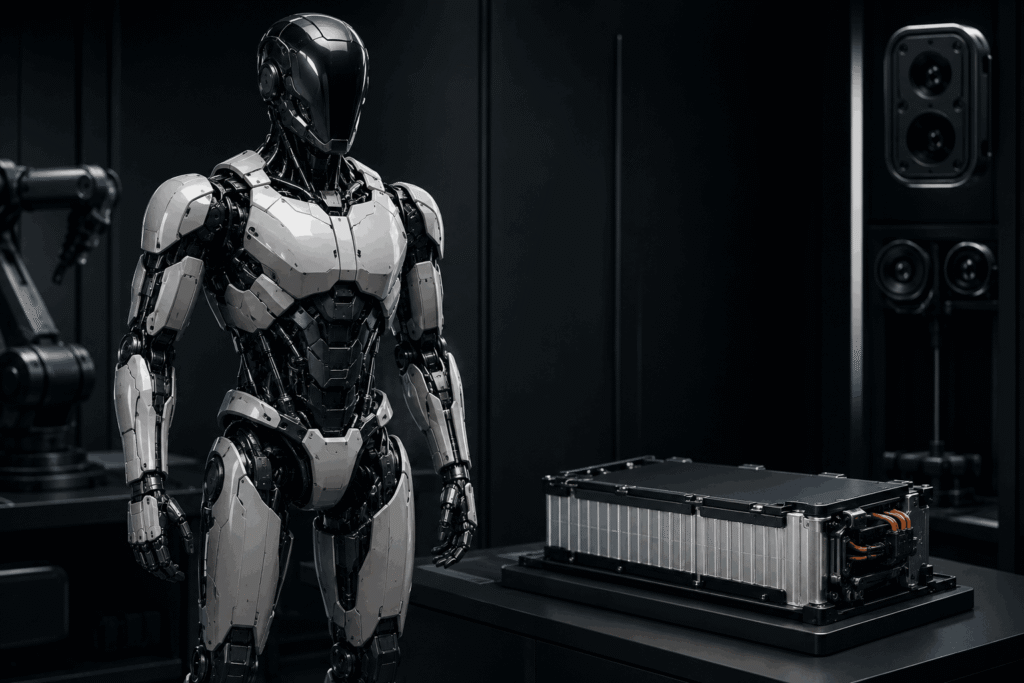
The T-800 stands 5 feet 8 inches and weighs approximately 165 pounds. The platform delivers 450 Newton meters of peak joint torque on a frame built to absorb real impact.
| Specification | EngineAI T-800 |
| Height | 5 feet 8 inches |
| Weight | Approximately 165 pounds |
| Peak joint torque | 450 Newton meters |
| Top speed | Approximately 7 mph |
| Battery | Solid-state, 4 to 5 hours runtime |
| Frame | Aviation-grade magnesium-aluminum alloy |
| Compute | NVIDIA Jetson Thor (Pro and Max configurations) |
| Perception | 360-degree LiDAR plus depth cameras |
| Degrees of freedom | 29 in the body plus 7 per dexterous hand |
| Starting price | $25,000 |
For the full spec sheet, pricing, and how it compares to other platforms, see our EngineAI T-800 robot profile.
.The solid-state battery first
The T-800 runs the first solid-state battery in a production humanoid per EngineAI’s positioning.
Solid-state chemistry delivers 4 to 5 hours of runtime while tolerating the impact loads combat generates. No other production humanoid ships with the technology today per EngineAI. Conventional lithium packs risk damage under repeated strikes. The battery choice is a combat requirement that doubles as an industrial durability signal. The full platform range, including 30 other tracked humanoids, sits inside the humanoid robot directory.
The Investment Angle: Combat as Industrial R&D
EngineAI uses URKL as a stress test at a scale no controlled lab environment can replicate. The fight data feeds the industrial product roadmap directly.
Every fight generates real-world data on balance recovery, impact tolerance, dynamic movement, and autonomous decision-making under pressure. That is exactly the data an industrial humanoid program needs and can rarely buy. The combat league is not a distraction from the product roadmap. The combat league is the product roadmap.
The question investors should ask is specific. What happens to the platform once the 32 software teams start shipping their competition-hardened algorithms into industrial applications? The answer decides how the T-800 converts spectacle into commercial value. The league also builds something no marketing budget can buy: branded demand.
Millions of viewers now know the EngineAI name through a highlight clip, and branded search is the hardest signal for competitors to displace. The category funding picture around EngineAI sits inside the robotics funding tracker. Investors tracking the public-market side can compare exposure options across the top autonomous robot ETFs of 2026.
Where the T-800 Fits in the Robot of the Week Series
The Robot of the Week series tracks one question per platform, and the T-800 answers the durability question.
Digit proved humanoids could work. The T-800 is proving they can fight. Combat performance under real impact is the hardest reliability benchmark the category has produced, and EngineAI turned it into a league.
Next week the series crosses the Atlantic. The HMND 01 from London-based Humanoid was built in seven months. The company reached unicorn status with $152 million in fresh funding. The design team made a deliberate choice most companies are not willing to make. The full breakdown arrives next episode.
Frequently Asked Questions
What is URKL?
URKL, the Ultimate Robot Knock-out Legend, is the world’s first full-scale humanoid robot combat league, founded by EngineAI. Thirty-two teams worldwide compete on the standardized T-800 platform, with software as the only differentiator. The league opened July 16, 2026 in Shenzhen.
What is the EngineAI T-800?
The T-800 is a combat-capable humanoid robot built by Shenzhen-based EngineAI. The platform serves as the standardized hardware for every URKL team and doubles as a stress-test vehicle for EngineAI’s industrial robotics roadmap.
What are the EngineAI T-800 specifications?
The T-800 stands 5 feet 8 inches, weighs approximately 165 pounds, and delivers 450 Newton meters of peak joint torque. The platform runs a solid-state battery for 4 to 5 hours and uses NVIDIA Jetson Thor compute on Pro and Max configurations. The body offers 29 degrees of freedom plus 7 per dexterous hand. Perception runs on 360-degree LiDAR and depth cameras for real-time environmental processing during a fight.
How much does the EngineAI T-800 cost?
The T-800 starts at $25,000. The price is aggressive for a 450 Newton meter platform with a solid-state battery and an aviation-grade magnesium-aluminum alloy frame.
Why did the headless robot keep fighting at URKL?
The Matador unit continued fighting after losing its head because the T-800 runs backup torso sensors and distributed perception. Head-mounted sensors are the primary input, and the torso array keeps balance, targeting, and movement running when the primary stack goes offline.
Key Takeaways: EngineAI T-800 Robot of the Week
The EngineAI T-800 is the standardized platform behind URKL, the world’s first full-scale humanoid combat league. URKL opened July 16, 2026 in Shenzhen, where a headless Matador kept fighting on backup torso sensors and made the platform famous. The T-800 delivers 450 Newton meters of peak torque on a solid-state battery running 4 to 5 hours.
The starting price is $25,000 on an aviation-grade alloy frame with NVIDIA Jetson Thor compute. Thirty-two teams compete on identical hardware, which makes every fight a software benchmark and a stress-test dataset for EngineAI’s industrial roadmap. Digit proved humanoids could work. The T-800 is proving they can take a hit. The Robot of the Week series continues next week with the HMND 01 from London-based Humanoid.
Disclaimer
The Robotic Life provides informational coverage of humanoid robotics companies and industry developments. Nothing in this article constitutes investment advice. Readers considering financial decisions based on humanoid robotics companies should consult a qualified financial advisor.